Nebula
A nebula is a giant cloud of gas (mostly hydrogen and helium) and cosmic dust situated between stars in the interstellar medium. Nebulae serve as sites of stellar birth and death—including emission nebulae that glow from ionized gas, reflection nebulae that scatter starlight, and dark nebulae that obscure background stars.
Source: science.nasa.gov
APODs including "Nebula"
Star Formation in the Eagle Nebula
14/03/2022
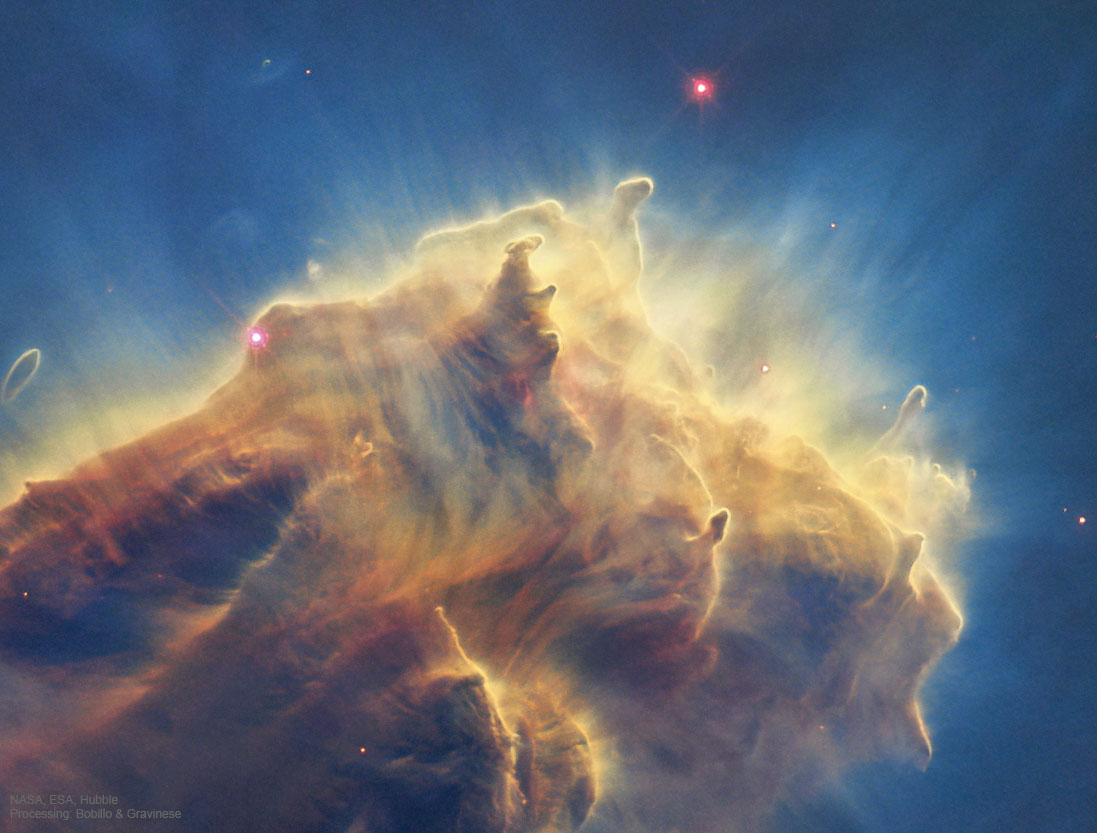
Where do stars form? One place, star forming regions known as "EGGs", are being uncovered at the end of this giant pillar of gas and dust in the Eagle Nebula (M16). Short for evaporating gaseous globules, EGGs are dense regions of mostly molecular hydrogen gas that fragment and gravitationally collapse to form stars. Light from the hottest and brightest of these new stars heats the end of the pillar and causes further evaporation of gas and dust -- revealing yet more EGGs and more young stars. This featured picture was created from exposures spanning over 30 hours with the Earth-orbiting Hubble Space Telescope in 2014, and digitally processed with modern software by experienced volunteers in Argentina. Newborn stars will gradually destroy their birth pillars over the next 100,000 years or so -- if a supernova doesn't destroy them first.