Nebula
A nebula is a giant cloud of gas (mostly hydrogen and helium) and cosmic dust situated between stars in the interstellar medium. Nebulae serve as sites of stellar birth and death—including emission nebulae that glow from ionized gas, reflection nebulae that scatter starlight, and dark nebulae that obscure background stars.
Source: science.nasa.gov
APODs including "Nebula"
In the Center of the Cat's Eye Nebula
10/07/2022
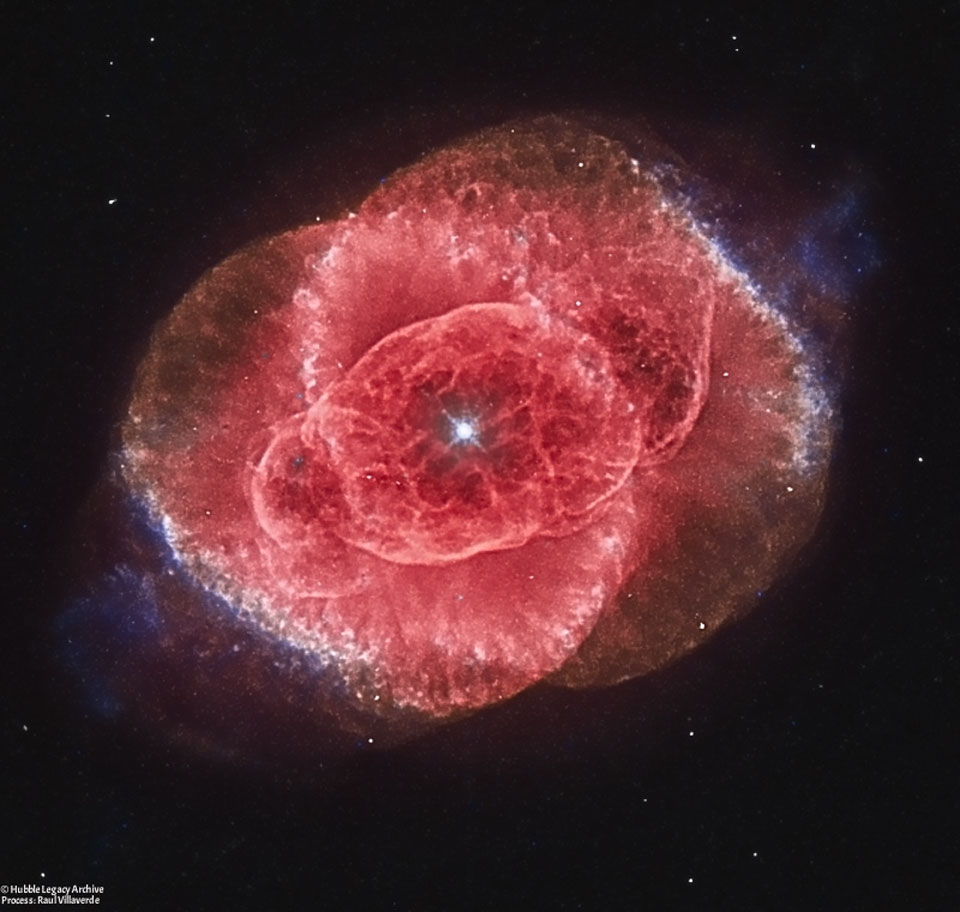
Three thousand light-years away, a dying star throws off shells of glowing gas. This image from the Hubble Space Telescope reveals the Cat's Eye Nebula (NGC 6543), to be one of the most complex planetary nebulae known. Spanning half a light-year, the features seen in the Cat's Eye are so complex that astronomers suspect the bright central object may actually be a binary star system. The term planetary nebula, used to describe this general class of objects, is misleading. Although these objects may appear round and planet-like in small telescopes, high resolution images with large telescopes reveal them to be stars surrounded by cocoons of gas blown off in the late stages of stellar evolution. Gazing into this Cat's Eye, astronomers may well be seeing more than detailed structure, they may be seeing the fate of our Sun, destined to enter its own planetary nebula phase of evolution ... in about 5 billion years.