Nebula
A nebula is a giant cloud of gas (mostly hydrogen and helium) and cosmic dust situated between stars in the interstellar medium. Nebulae serve as sites of stellar birth and death—including emission nebulae that glow from ionized gas, reflection nebulae that scatter starlight, and dark nebulae that obscure background stars.
Source: science.nasa.gov
APODs including "Nebula"
Stardust and Comet Tails
20/08/2022
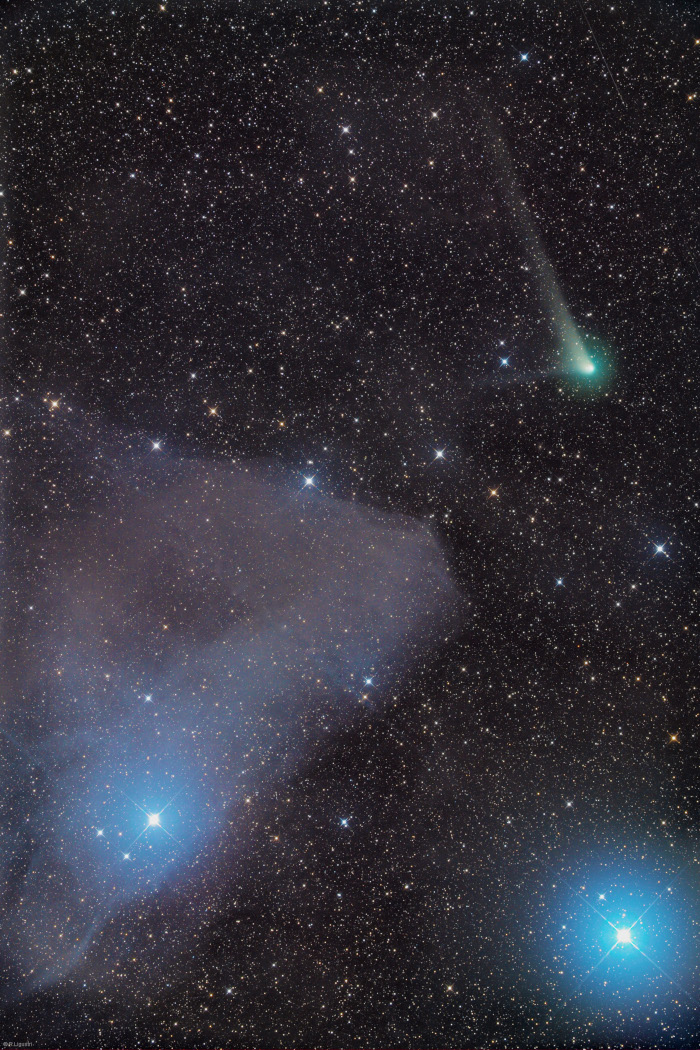
Heading for its closest approach to the Sun, or perihelion, on December 19 comet C/2017 K2 (PanSTARRS) remains a sight for telescopic observers as it sweeps through planet Earth's skies in the constellation Scorpius. The comet currently sports a greenish coma, long whitish dust tail, and short ion tail in this deep image from August 18. The 2x3 degree wide field of view includes part of the dusty nebula IC 4592 reflecting blue starlight. Also known as the Blue Horsehead Nebula, IC 4592 is about 400 light-years distant while the comet is just under 17 light-minutes away. First spotted at a distance well beyond the orbit of Saturn C/2017 K2 is on its maiden voyage to the inner solar system, a pristine visitor from the remote Oort cloud.