Nebula
A nebula is a giant cloud of gas (mostly hydrogen and helium) and cosmic dust situated between stars in the interstellar medium. Nebulae serve as sites of stellar birth and death—including emission nebulae that glow from ionized gas, reflection nebulae that scatter starlight, and dark nebulae that obscure background stars.
Source: science.nasa.gov
APODs including "Nebula"
Magellanic Clouds over Chile
11/02/2023
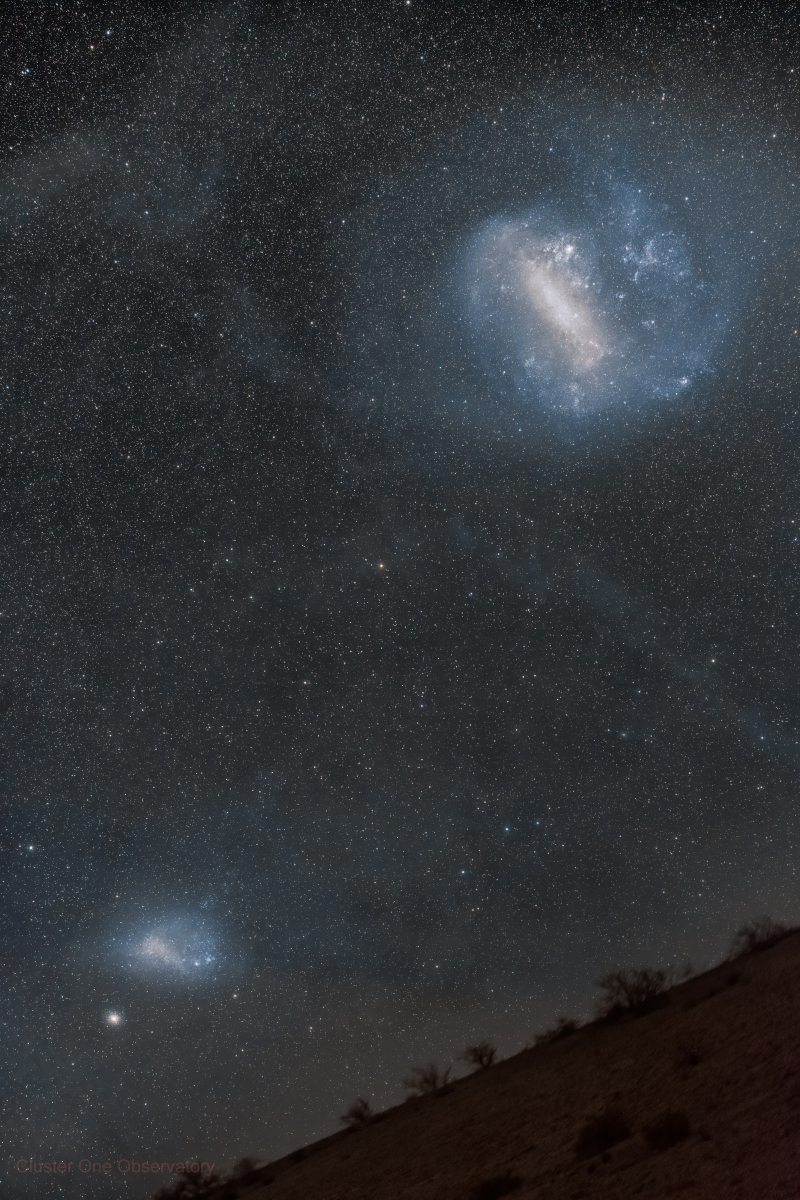
The two prominent clouds in this Chilean Atacama Desert skyscape captured on January 21 actually lie beyond our Milky Way galaxy. Known as the Large and the Small Magellanic Clouds they are so named for the 16th century Portuguese explorer Ferdinand Magellan, leader of the first circumnavigation of planet Earth. Famous jewels of southern hemisphere skies, they are the brightest satellite galaxies of the Milky Way. The larger cloud is some 160,000 light-years, and the smaller 210,000 light-years distant. While both are irregular dwarf galaxies in their own right, they exhibit central barred structures in the deep wide-angle view. Wide and deep exposures also reveal faint dusty galactic cirrus nebulae and the imprints of gravitational tidal interactions between the Large and Small Magellanic Clouds.