Nebula
A nebula is a giant cloud of gas (mostly hydrogen and helium) and cosmic dust situated between stars in the interstellar medium. Nebulae serve as sites of stellar birth and death—including emission nebulae that glow from ionized gas, reflection nebulae that scatter starlight, and dark nebulae that obscure background stars.
Source: science.nasa.gov
APODs including "Nebula"
Milky Way over a Turquoise Wonderland
29/05/2023
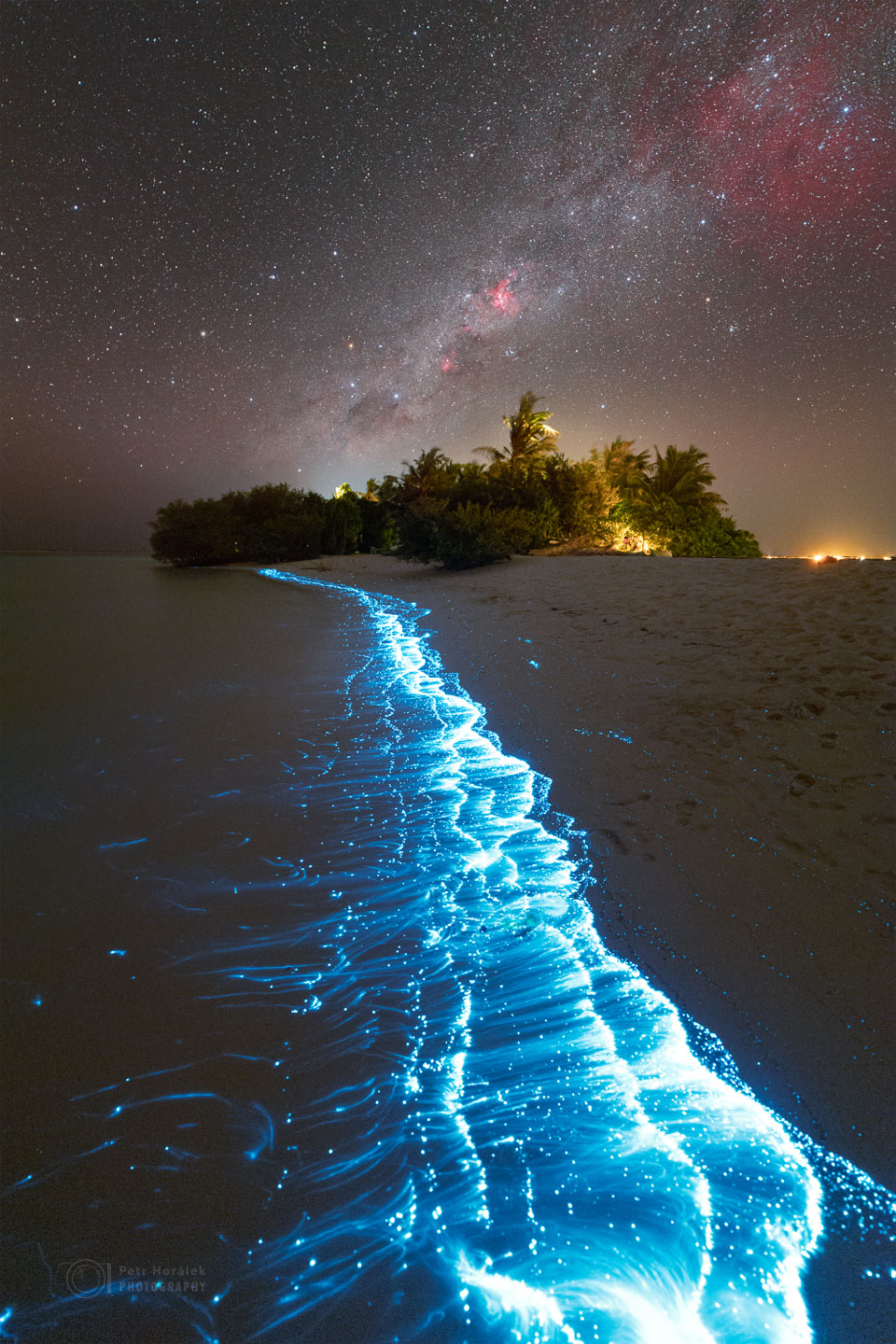
What glows there? The answer depends: sea or sky? In the sea, the unusual blue glow is bioluminescence. Specifically, the glimmer arises from Noctiluca scintillans, single-celled plankton stimulated by the lapping waves. The plankton use their glow to startle and illuminate predators. This mid-February display on an island in the Maldives was so intense that the astrophotographer described it as a turquoise wonderland. In the sky, by contrast, are the more familiar glows of stars and nebulas. The white band rising from the artificially-illuminated green plants is created by billions of stars in the central disk of our Milky Way Galaxy. Also visible in the sky is the star cluster Omega Centauri, toward the left, and the famous Southern Cross asterism in the center. Red-glowing nebulas include the bright Carina Nebula, just right of center, and the expansive Gum Nebula on the upper right.