Nebula
A nebula is a giant cloud of gas (mostly hydrogen and helium) and cosmic dust situated between stars in the interstellar medium. Nebulae serve as sites of stellar birth and death—including emission nebulae that glow from ionized gas, reflection nebulae that scatter starlight, and dark nebulae that obscure background stars.
Source: science.nasa.gov
APODs including "Nebula"
The Eagle Nebula with X-ray Hot Stars
25/07/2023
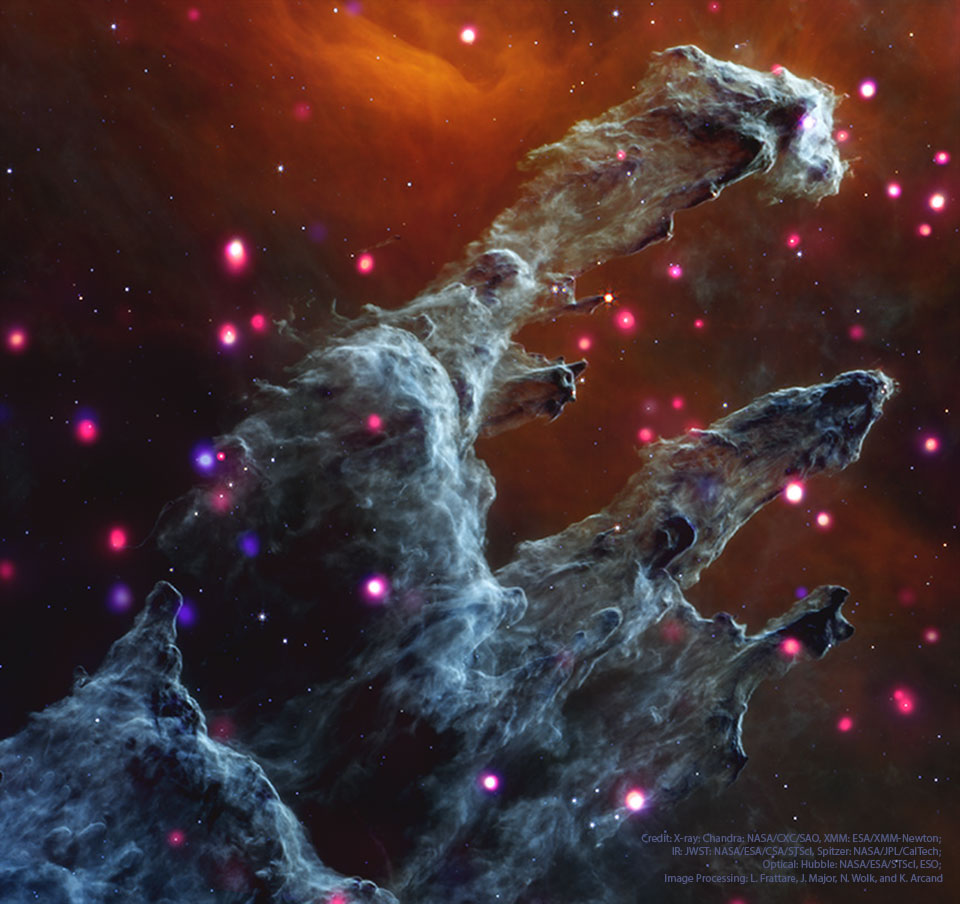
What do the famous Eagle Nebula star pillars look like in X-ray light? To find out, NASA's orbiting Chandra X-ray Observatory peered in and through these interstellar mountains of star formation. It was found that in M16 the dust pillars themselves do not emit many X-rays, but a lot of small-but-bright X-ray sources became evident. These sources are shown as bright dots on the featured image which is a composite of exposures from Chandra (X-rays), XMM (X-rays), JWST (infrared), Spitzer (infrared), Hubble (visible), and the VLT (visible). What stars produce these X-rays remains a topic of research, but some are hypothesized to be hot, recently-formed, low-mass stars, while others are thought to be hot, older, high-mass stars. These X-ray hot stars are scattered around the frame -- the previously identified Evaporating Gaseous Globules (EGGS) seen in visible light are not currently hot enough to emit X-rays.