Nebula
A nebula is a giant cloud of gas (mostly hydrogen and helium) and cosmic dust situated between stars in the interstellar medium. Nebulae serve as sites of stellar birth and death—including emission nebulae that glow from ionized gas, reflection nebulae that scatter starlight, and dark nebulae that obscure background stars.
Source: science.nasa.gov
APODs including "Nebula"
Along the Taurus Molecular Cloud
23/11/2023
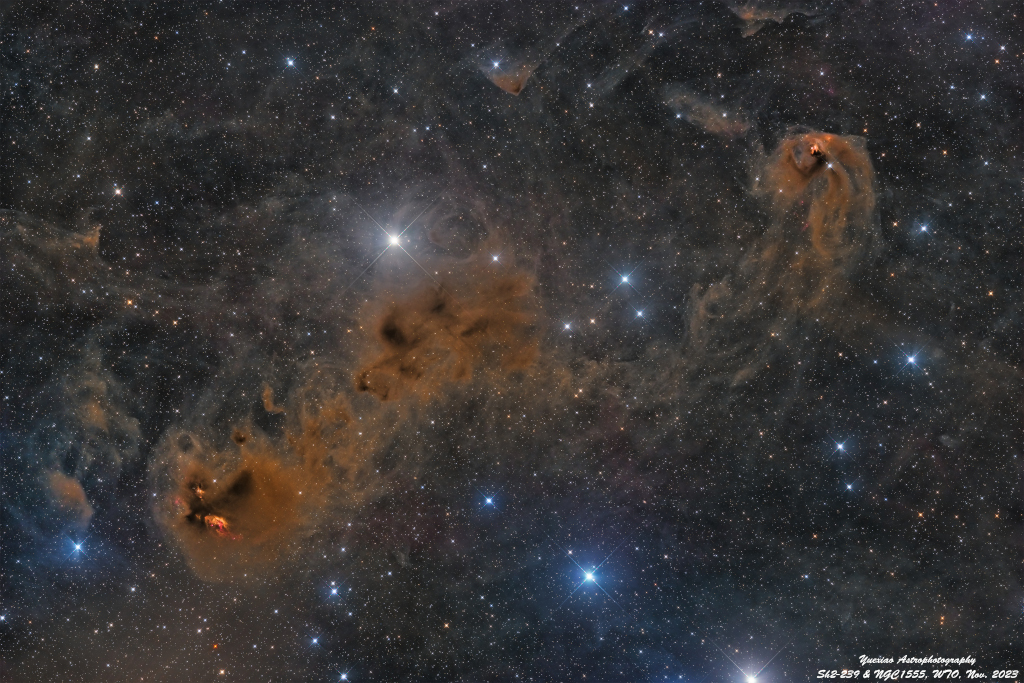
The cosmic brush of star formation composed this interstellar canvas of emission, dust, and dark nebulae. A 5 degree wide telescopic mosaic, it frames a region found north of bright star Aldebaran on the sky, at an inner wall of the local bubble along the Taurus molecular cloud. At lower left, emission cataloged as Sh2-239 shows signs of embedded young stellar objects. The region's Herbig-Haro objects, nebulosities associated with newly born stars, are marked by tell-tale reddish jets of shocked hydrogen gas. Above and right T Tauri, the prototype of the class of T Tauri variable stars, is next to a yellowish nebula historically known as Hind's Variable Nebula (NGC 1555). T Tauri stars are now generally recognized as young, less than a few million years old, sun-like stars still in the early stages of formation.