Nebula
A nebula is a giant cloud of gas (mostly hydrogen and helium) and cosmic dust situated between stars in the interstellar medium. Nebulae serve as sites of stellar birth and death—including emission nebulae that glow from ionized gas, reflection nebulae that scatter starlight, and dark nebulae that obscure background stars.
Source: science.nasa.gov
APODs including "Nebula"
The Crab Nebula from Visible to X-Ray
23/07/2024
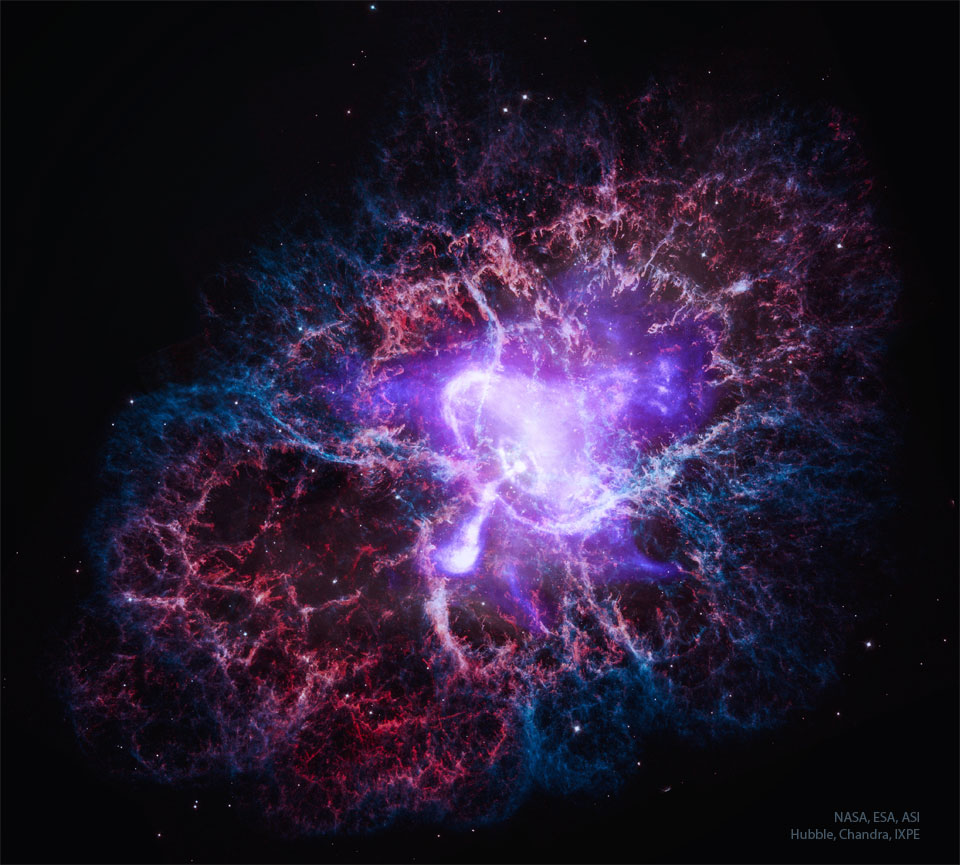
What powers the Crab Nebula? A city-sized magnetized neutron star spinning around 30 times a second. Known as the Crab Pulsar, it is the bright spot in the center of the gaseous swirl at the nebula's core. About 10 light-years across, the spectacular picture of the Crab Nebula (M1) frames a swirling central disk and complex filaments of surrounding and expanding glowing gas. The picture combines visible light from the Hubble Space Telescope in red and blue with X-ray light from the Chandra X-ray Observatory shown in white, and diffuse X-ray emission detected by Imaging X-ray Polarimetry Explorer (IXPE) in diffuse purple. The central pulsar powers the Crab Nebula's emission and expansion by slightly slowing its spin rate, which drives out a wind of energetic electrons. The featured image released today, the 25th Anniversary of the launch of NASA's flagship-class X-ray Observatory: Chandra. Many Discoveries: Chandra Celebrates 25th Anniversary