Nebula
A nebula is a giant cloud of gas (mostly hydrogen and helium) and cosmic dust situated between stars in the interstellar medium. Nebulae serve as sites of stellar birth and death—including emission nebulae that glow from ionized gas, reflection nebulae that scatter starlight, and dark nebulae that obscure background stars.
Source: science.nasa.gov
APODs including "Nebula"
The Heart of the Soul Nebula
09/12/2025
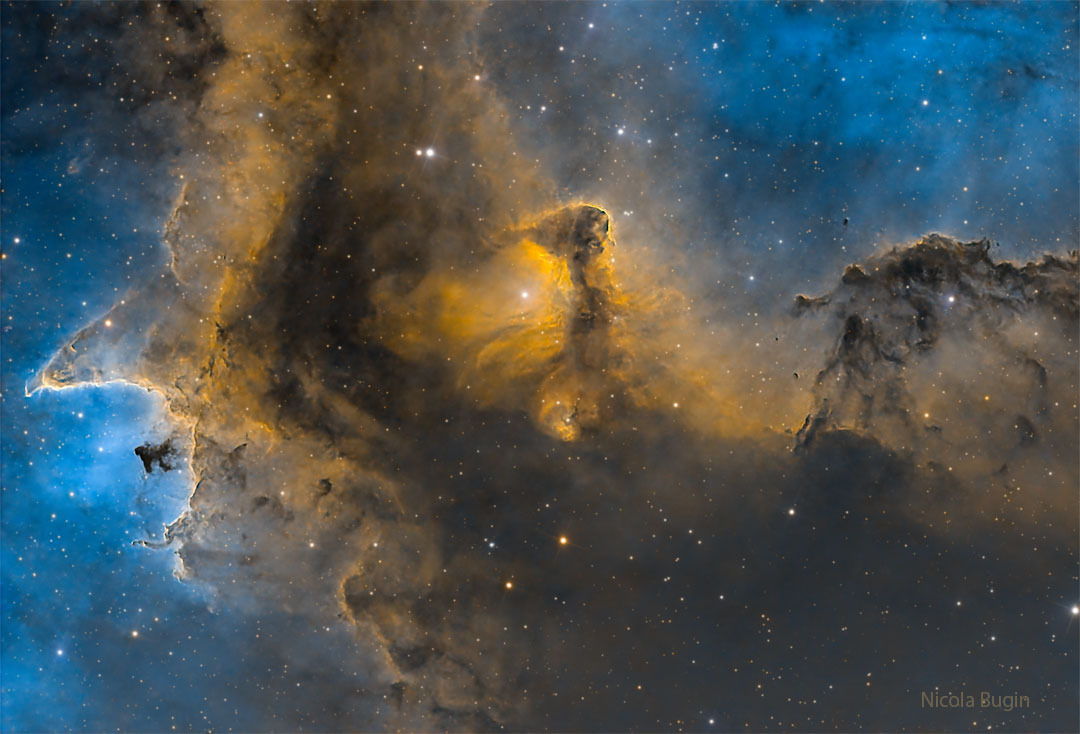
This cosmic close-up looks deep inside the Soul Nebula. The dark and brooding dust clouds outlined by bright ridges of glowing gas are cataloged as IC 1871. About 25 light-years across, the telescopic field of view spans only a small part of the much larger Heart and Soul nebulae. At an estimated distance of 6,500 light-years, the star-forming complex lies within the Perseus spiral arm of the Milky Way, seen in planet Earth's skies toward the constellation of the Queen of Aethiopia (Cassiopeia). An example of triggered star formation, the dense star-forming clouds of IC 1871 are themselves sculpted by the intense winds and radiation of the region's massive young stars. This color image adopts a palette made popular in Hubble images of star-forming regions.