Nebula
A nebula is a giant cloud of gas (primarily hydrogen and helium) and dust in space—part of the interstellar medium. Nebulae serve as both stellar nurseries and the aftermath of dying stars, making them key players in the life cycle of stars.
There are several main types of nebulae:
Emission nebulae are ionized gas clouds that glow brightly from ultraviolet radiation emitted by nearby hot stars (H II regions), such as the Orion Nebula.
Reflection nebulae are dusty clouds that scatter light from nearby stars, often appearing blue—like NGC 1999.
Dark nebulae are dense dust clouds that block background starlight, seen as dark silhouettes (e.g., the Horsehead Nebula).
Planetary nebulae are shells of gas expelled by dying medium-mass stars, such as the Helix Nebula.
Supernova remnants are expanding nebulae formed from supernova explosions, such as the Cygnus Loop and Veil Nebula, rich in heavy elements.
Nebulae vary widely in size and shape: some span hundreds of light-years and showcase intricate structures like pillars and filaments, which have been imaged by Hubble and JWST.
Despite their vast size, they are very low density—sometimes just 0.1 atoms/cm³—yet they can contain enough mass to form thousands of stars. Gravity and external forces like shockwaves from nearby supernovae trigger regions to collapse and form new stars.
Nebulae enrich galactic chemistry: elements forged in stars are returned to the interstellar medium, fueling future star and planet formation.
They are studied across the electromagnetic spectrum—from radio waves to gamma rays—using observatories like Hubble, JWST, Chandra, and Earth-based telescopes. Their spectacular beauty and scientific significance make them central to both research and public engagement.
Sources
APODs including "Nebula"
NGC 2170: The Angel Nebula
19 May 2026
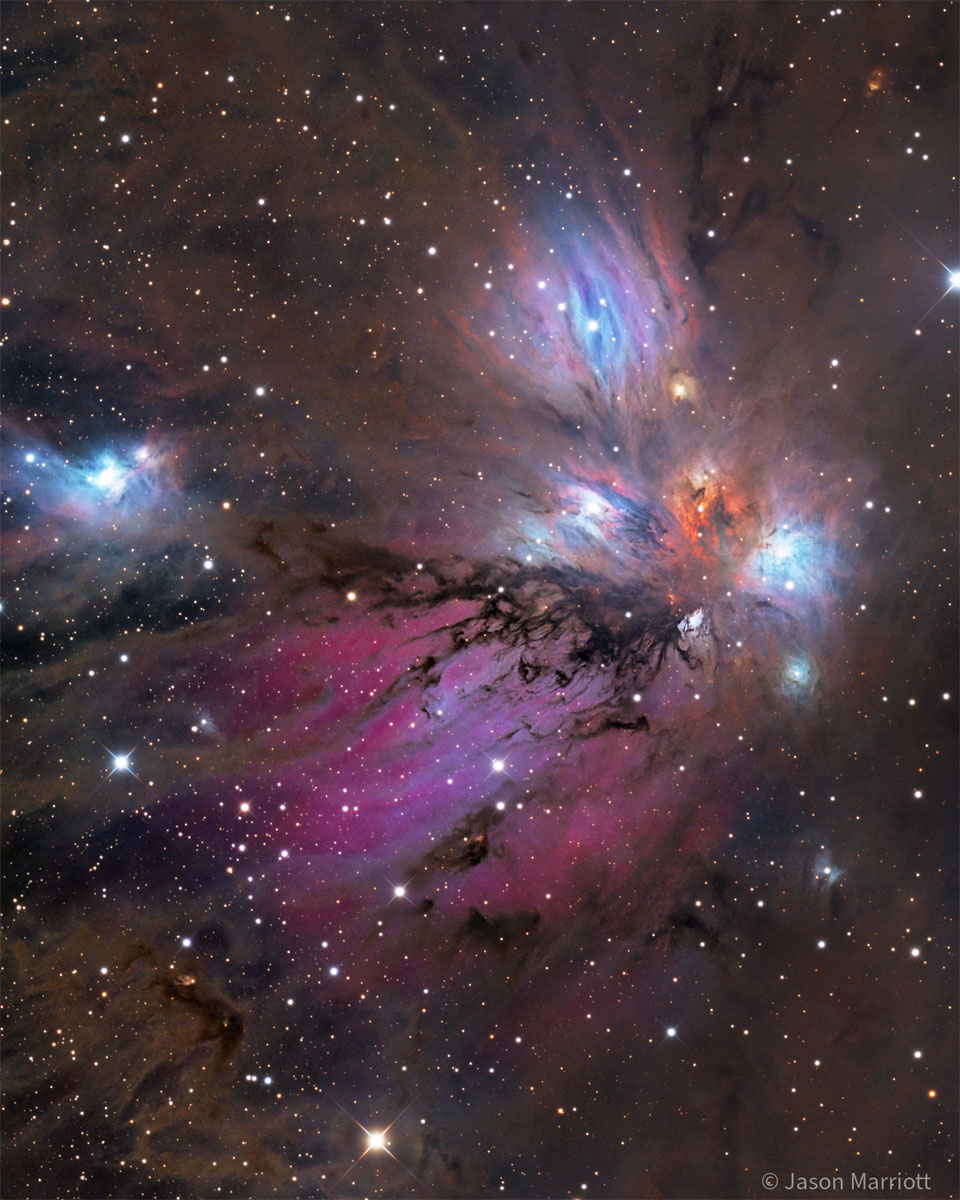
Is this a painting or a photograph? In this celestial abstract art composed with a cosmic brush, dusty nebula NGC 2170, also known as the Angel Nebula, shines just above the image center. Reflecting the light of nearby hot stars, NGC 2170 is joined by other bluish reflection nebulae, a red emission region, many dark absorption nebulae, and a backdrop of colorful stars. Like the common household items that abstract painters often choose for their subjects, the clouds of gas, dust, and hot stars featured here are also commonly found in a setting like this one -- a massive, star-forming molecular cloud in the constellation of the Unicorn (Monoceros). The giant molecular cloud Mon R2, is impressively close, estimated to be only 2,400 light-years or so away. At that distance, this canvas would be over 60 light-years across. Almost Hyperspace: Random APOD Generator