NEOWISE
NEOWISE (Near‑Earth Object Wide‑field Infrared Survey Explorer) is a NASA mission that repurposed the WISE spacecraft, initially launched in 2009, to detect and characterize asteroids and comets. Using infrared sensors operating at 3.4 and 4.6 µm wavelengths, NEOWISE has cataloged hundreds of thousands of minor planets—including Near‑Earth Objects—providing critical data on their sizes, orbits, and compositions.
Source: science.nasa.gov
APODs including "NEOWISE"
The Structured Tails of Comet NEOWISE
22/07/2020
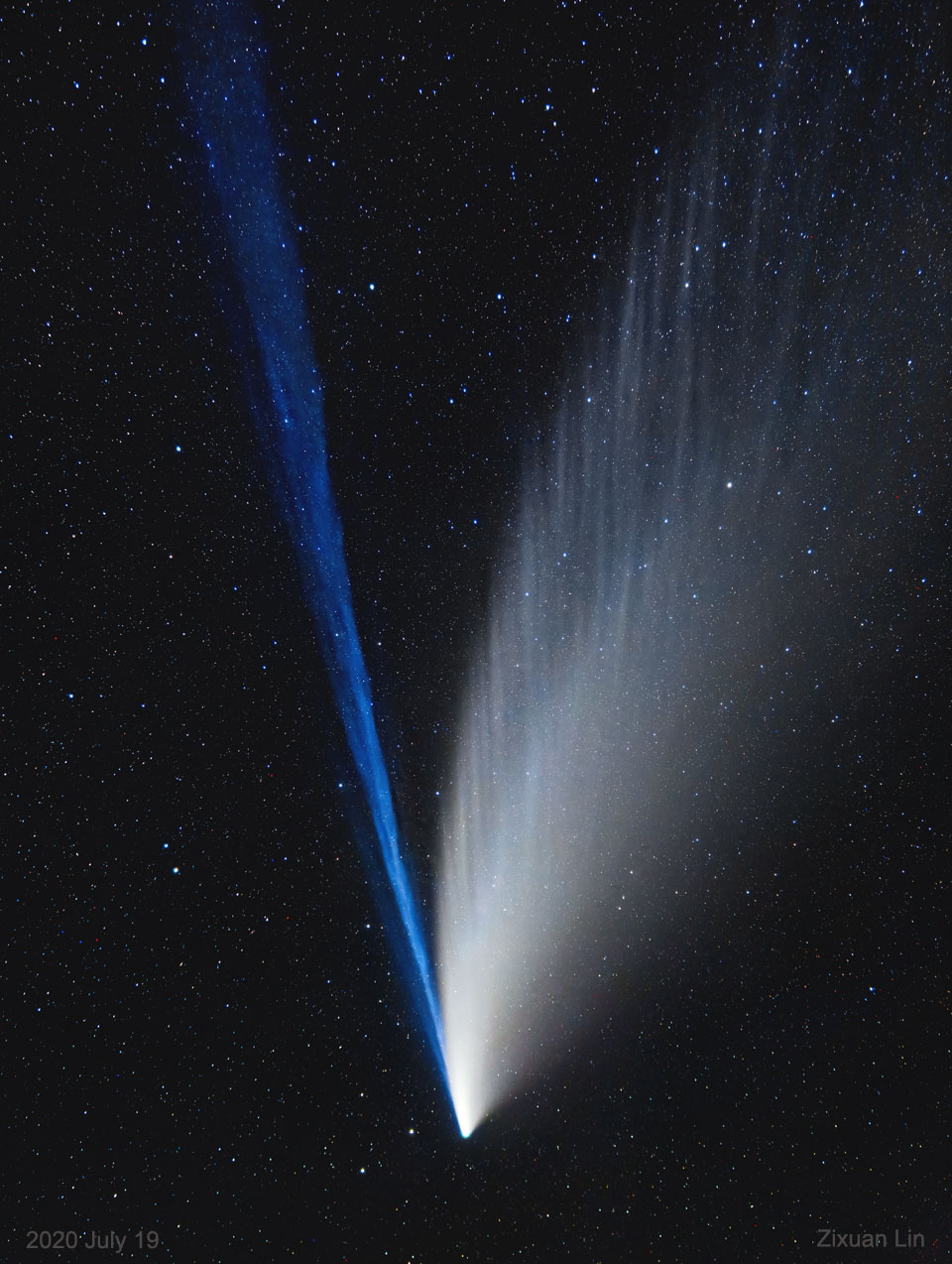
What is creating the structure in Comet NEOWISE's tails? Of the two tails evident, the blue ion tail on the left points directly away from the Sun and is pushed out by the flowing and charged solar wind. Structure in the ion tail comes from different rates of expelled blue-glowing ions from the comet's nucleus, as well as the always complex and continually changing structure of our Sun's wind. Most unusual for Comet C/2020 F3 (NEOWISE), though, is the wavy structure of its dust tail. This dust tail is pushed out by sunlight, but curves as heavier dust particles are better able to resist this light pressure and continue along a solar orbit. Comet NEOWISE's impressive dust-tail striations are not fully understood, as yet, but likely related to rotating streams of sun-reflecting grit liberated by ice melting on its 5-kilometer wide nucleus. The featured 40-image conglomerate, digitally enhanced, was captured three days ago through the dark skies of the Gobi Desert in Inner Mongolia, China. Comet NEOWISE will make it closest pass to the Earth tomorrow as it moves out from the Sun. The comet, already fading but still visible to the unaided eye, should fade more rapidly as it recedes from the Earth. Notable NEOWISE Images Submitted to APOD: July 21 || 20 || 19 || 18 || 17 || 16 || 15 || 14 || 13 || 12 || 11 || 10 & earlier ||