New Horizons
A NASA spacecraft launched in 2006 to study Pluto, its moons, and other objects in the Kuiper Belt. It performed a historic flyby of Pluto on July 14, 2015, providing the first close-up images of the dwarf planet.
Source: nasa.gov
APODs including "New Horizons"
Pluto: New Horizons
18/10/2001
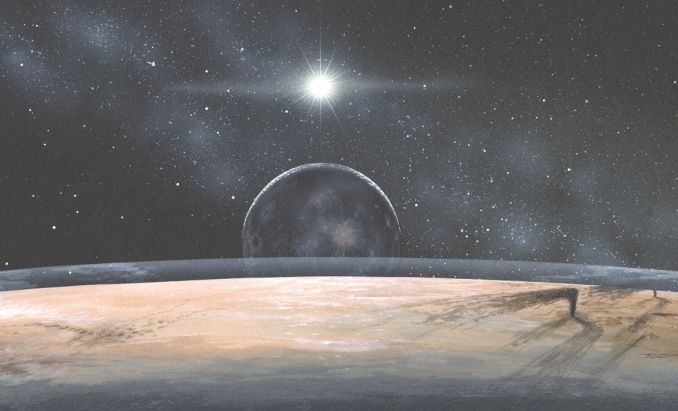
Pluto's horizon spans the foreground in this artist's vision, gazing sunward across that distant and not yet explored world. Titled New Horizons, the painting also depicts Pluto's companion, Charon, as a darkened, ghostly apparition with a luminous crescent against a starry background. Beyond Charon, the diminished Sun is immersed in a flattened cloud of zodiacal dust. Here, Pluto's ruddy colors are based on existing astronomical observations while imagined but scientifically tenable details provided by the artist include high atmospheric cirrus and dark plumes from surface vents, in analogy to Neptune's large moon Triton explored by the Voyager 2 spacecraft in 1989. Craters suggest bombardment by Kuiper Belt objects, a newly understood population of outer solar system bodies likely related to the Pluto-Charon system. NASA is now considering a future robotic reconnaissance mission to Pluto-Charon and the Kuiper Belt which could reach the distant worlds late in the next decade.