New Horizons
A NASA spacecraft launched in 2006 to study Pluto, its moons, and other objects in the Kuiper Belt. It performed a historic flyby of Pluto on July 14, 2015, providing the first close-up images of the dwarf planet.
Source: nasa.gov
APODs including "New Horizons"
Watch Jupiter Rotate
12/03/2007
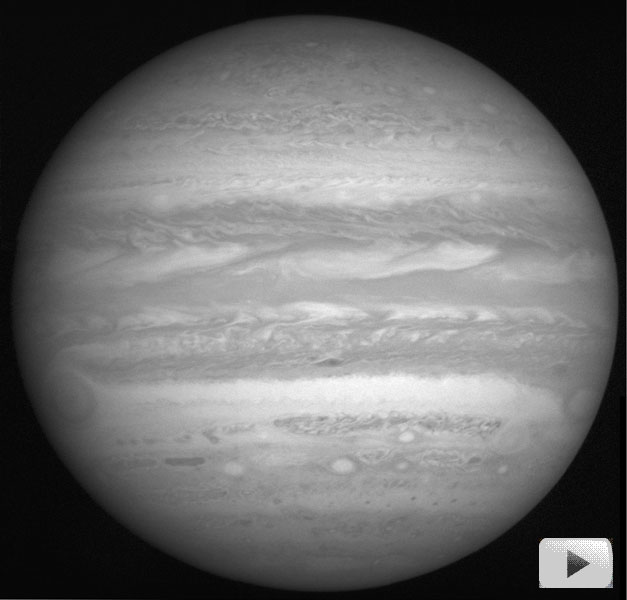
What would it be like to coast by Jupiter and watch it rotate? This was just the experience of the New Horizons spacecraft as it approached and flew by Jupiter earlier this year. Clicking on the image will bring up a movie of what the robotic spacecraft saw. Visible above in the extensive atmosphere of the Solar System's largest planet are bands and belts of light and dark clouds, as well as giant rotating storm systems seen as ovals. Other movies compiled by New Horizons and other passing spacecraft have captured the clouds swirling and moving relative to themselves. Jupiter has a diameter of about eleven times that of our Earth, and rotates once in about 10 hours. The robotic New Horizons spacecraft continues to speed toward the outer Solar System where it is expected to approach Pluto in 2015.