NIRCam
The Near-Infrared Camera aboard the James Webb Space Telescope, capable of capturing high-resolution images in the near-infrared spectrum. NIRCam has been instrumental in studying star formation in regions like NGC 346.
Source: nasa.gov
APODs including "NIRCam"
Shakespeare in Space
29/12/2023
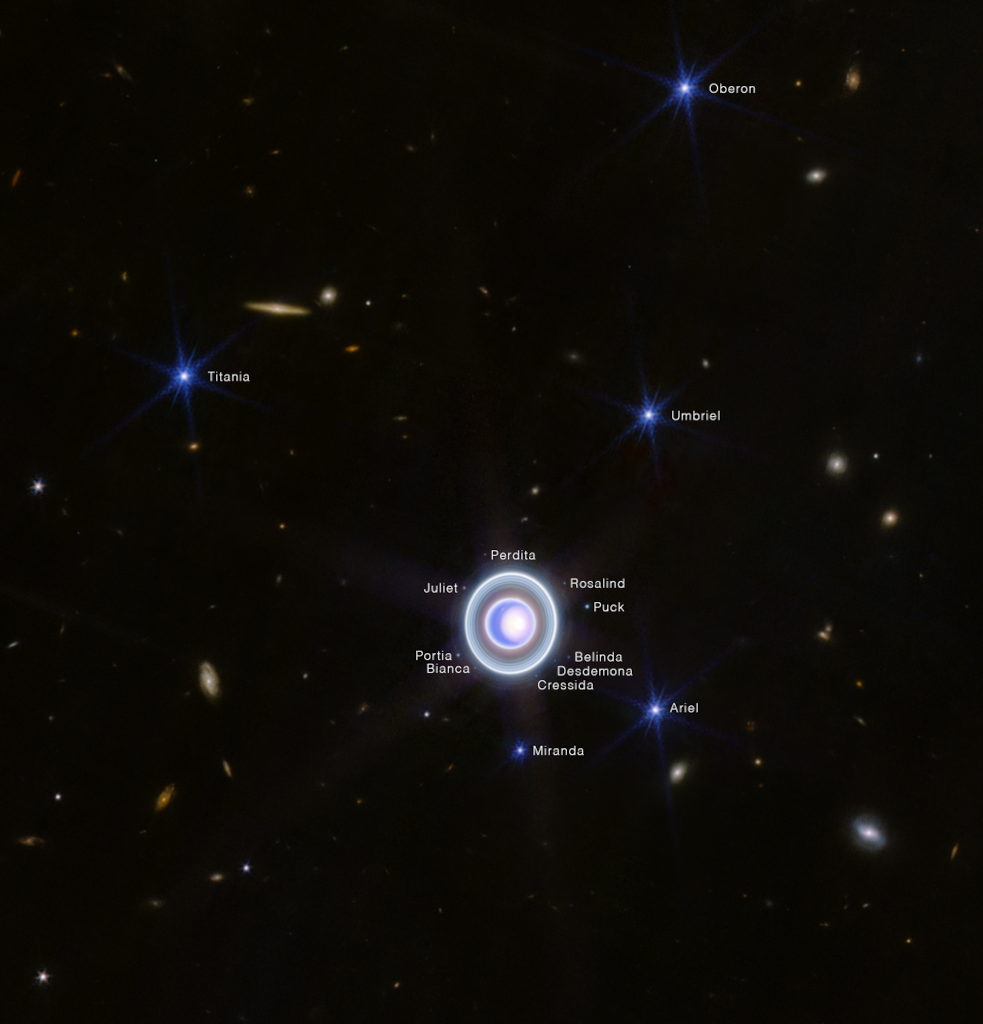
In 1986, Voyager 2 became the only spacecraft to explore ice giant planet Uranus close up. Still, this newly released image from the NIRCam (Near-Infrared Camera) on the James Webb Space Telescope offers a detailed look at the distant world. The tilted outer planet rotates on its axis once in about 17 hours. Its north pole is presently pointed near our line of sight, offering direct views of its northern hemisphere and a faint but extensive system of rings. Of the giant planet's 27 known moons, 14 are annotated in the image. Mixed with fuzzy background galaxies, the brighter moons show hints of Webb's characteristic diffraction spikes. And though these worlds of the outer Solar System were unknown in Shakespearean times, all but two of the 27 Uranian moons are named for characters in the English bard's plays.