Opportunity
Opportunity was a NASA Mars rover, part of the Mars Exploration Rover mission, that landed in Meridiani Planum on January 25, 2004. Originally designed for a 90‑sol mission, it operated for nearly 15 years—more than 5,000 sols—traversing over 45 km and providing strong evidence that Mars once held liquid water. It ceased communications after a global dust storm in June 2018 and was declared complete in February 2019.
Source: science.nasa.gov
APODs including "Opportunity"
Exploring Comet Tails
13/04/2000
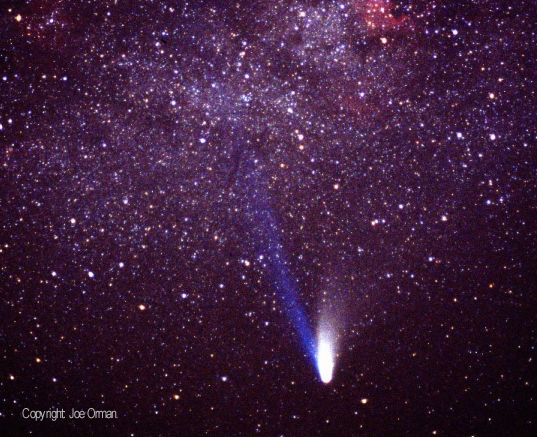
Comets are known for their tails. In the spring of 1997 and 1996 Comet Hale-Bopp (above) and Comet Hyakutake gave us stunning examples as they passed near the Sun. These extremely active comets were bright, naked-eye spectacles offering researchers an opportunity to telescopically explore the composition of primordial chunks of our solar system by studying their long and beautiful tails. But it has only recently been discovered that surprising readings from experiments on-board the interplanetary Ulysses probe which lasted for several hours on May 1, 1996, indicate the probe passed through comet Hyakutake's tail! Ulysses experiments were intended to study the Sun and solar wind and the spacecraft-comet encounter was totally unanticipated. Relative positions of Ulysses and Hyakutake on that date indicate that this comet's ion tail stretched an impressive 360 million miles or about four times the Earth-Sun distance. This makes Hyakutake's tail the longest ever recorded and suggests that comet tails are much longer than previously believed.