Parker Solar Probe
The Parker Solar Probe is a NASA spacecraft launched in 2018 to study the Sun's outer atmosphere. It is designed to withstand extreme heat and radiation as it approaches within 3.8 million miles of the solar surface, providing unprecedented data on solar activity and space weather.
Source: science.nasa.gov
APODs including "Parker Solar Probe"
A Venus Flyby
25/02/2021
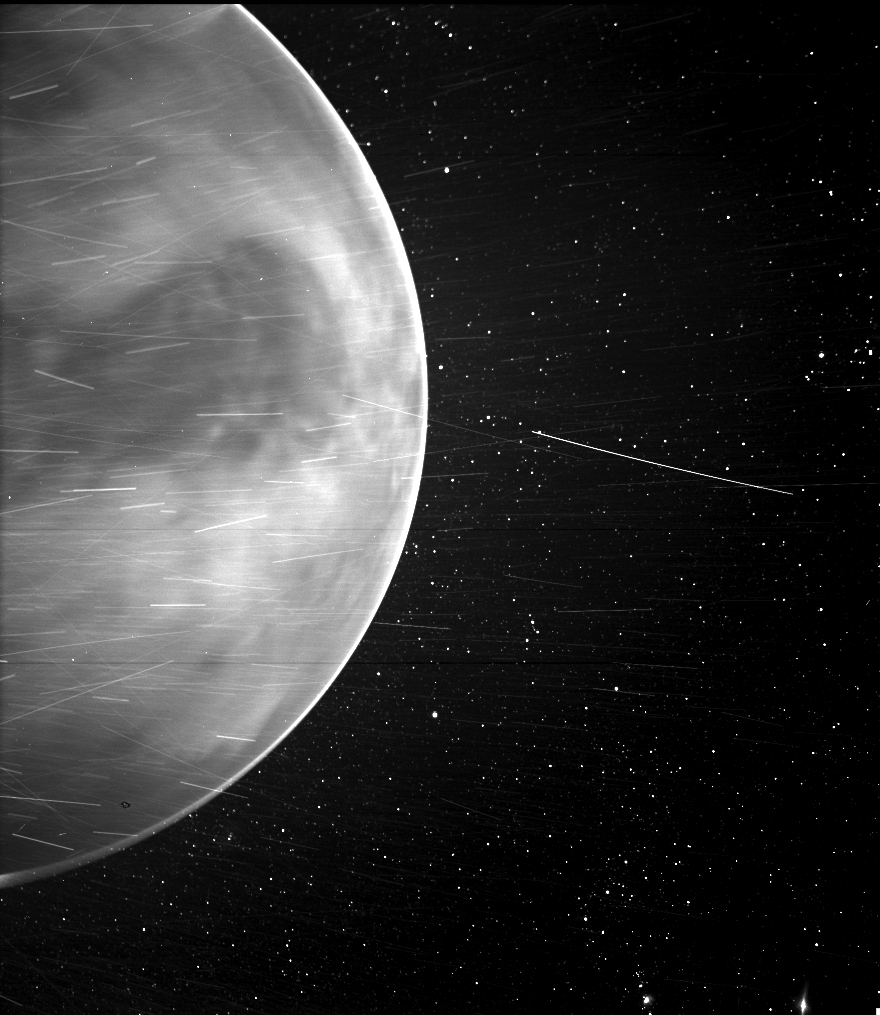
On a mission to explore the inner heliosphere and solar corona, on July 11, 2020 the Wide-field Imager on board NASA's Parker Solar Probe captured this stunning view of the nightside of Venus at distance of about 12,400 kilometers (7,693 miles). The spacecraft was making the third of seven gravity-assist flybys of the inner planet. The gravity-asssist flybys are designed to use the approach to Venus to help the probe alter its orbit to ultimately come within 6 million kilometers (4 million miles) of the solar surface in late 2025. A surprising image, the side-looking camera seems to peer through the clouds to show a dark feature near the center known as Aphrodite Terra, the largest highland region on the Venusian surface. The bright rim at the edge of the planet is nightglow likely emitted by excited oxygen atoms recombining into molecules in the upper reaches of the atmosphere. Bright streaks and blemishes throughout the image are likely due to energetic charged particles, and dust near the camera reflecting sunlight. Skygazers from planet Earth probably recognize the familiar stars of Orion's belt and sword at lower right.