Perihelion
Perihelion is the point in the orbit of a planet or other celestial body where it is closest to the Sun. For Earth, perihelion occurs annually in early January, when the planet is about 147 million kilometers (91 million miles) from the Sun.
Source: ssd.jpl.nasa.gov
APODs including "Perihelion"
Comet ISON Before and After
29/11/2013
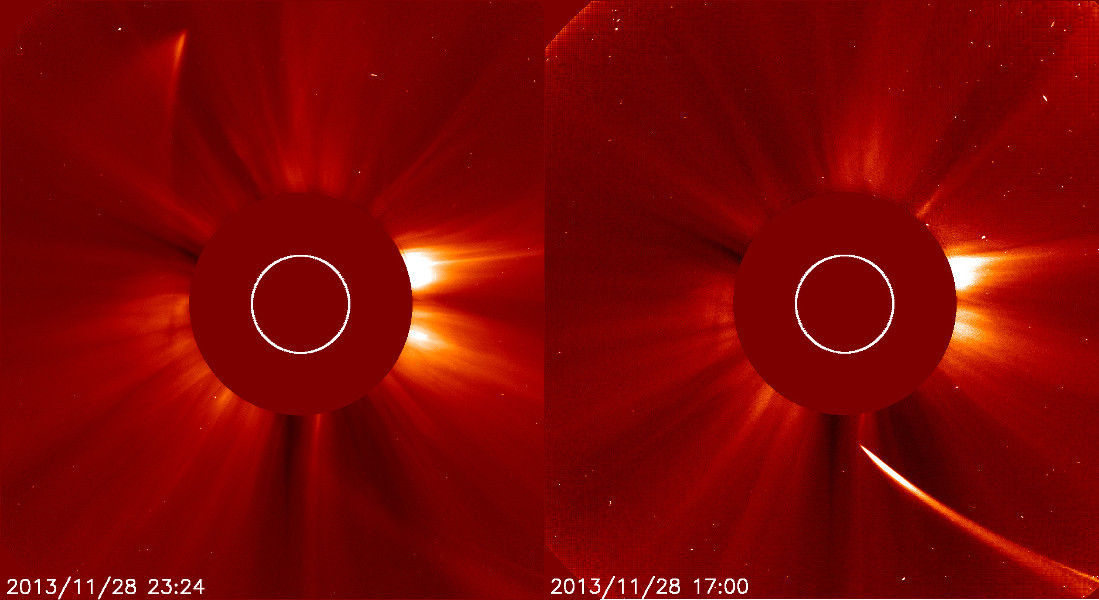
Sungrazing Comet ISON reached perihelion, its closest approach to the Sun, yesterday, November 28, at 18:45 UT. The comet passed just over 1 million kilometers above the solar surface, a distance less than the diameter of the Sun. These two panels follow ISON before (right) and after its close approach, imaged by the LASCO instrument onboard the Sun staring SOHO spacecraft. Overwhelming sunlight is blocked by LASCO's central occulting disk with a white circle indicating the Sun's positon and scale. The bright comet is seen along its path at the bottom of the before panel, but something much fainter exits near the top of the after panel, potentially a dust tail reforming from the debris left from ISON's perihelion passage.