Perihelion
Perihelion is the point in the orbit of a planet or other celestial body where it is closest to the Sun. For Earth, perihelion occurs annually in early January, when the planet is about 147 million kilometers (91 million miles) from the Sun.
Source: ssd.jpl.nasa.gov
APODs including "Perihelion"
The Tail of a Christmas Comet
25/12/2021
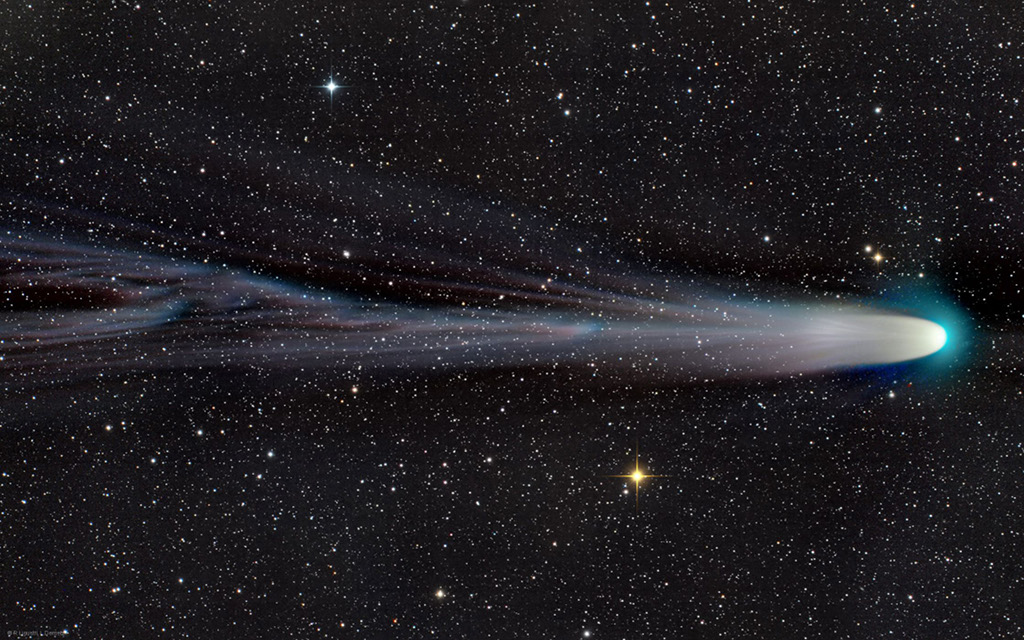
The tail of a comet streams across this three degree wide telescopic field of view captured under dark Namibian skies on December 21. In outburst only a few days ago and just reaching naked eye visibility Comet Leonard (C/2021 A1) is this year's brightest comet. Binoculars will make the diffuse comet easier to spot though, close to the western horizon after sunset. Details revealed in the sharp image show the comet's coma with a greenish tinge, and follow the interaction of the comet's ion tail with magnetic fields in the solar wind. After passing closest to Earth on December 12 and Venus on December 18, Comet Leonard is heading toward perihelion, its closest approach to the Sun on January 3rd. Appearing in late December's beautiful evening skies Comet Leonard has also become known as 2021's Christmas Comet. Launch Update: James Webb Space Telescope