Perihelion
Perihelion is the point in the orbit of a planet or other celestial body where it is closest to the Sun. For Earth, perihelion occurs annually in early January, when the planet is about 147 million kilometers (91 million miles) from the Sun.
Source: ssd.jpl.nasa.gov
APODs including "Perihelion"
Circling the Sun
13/01/2024
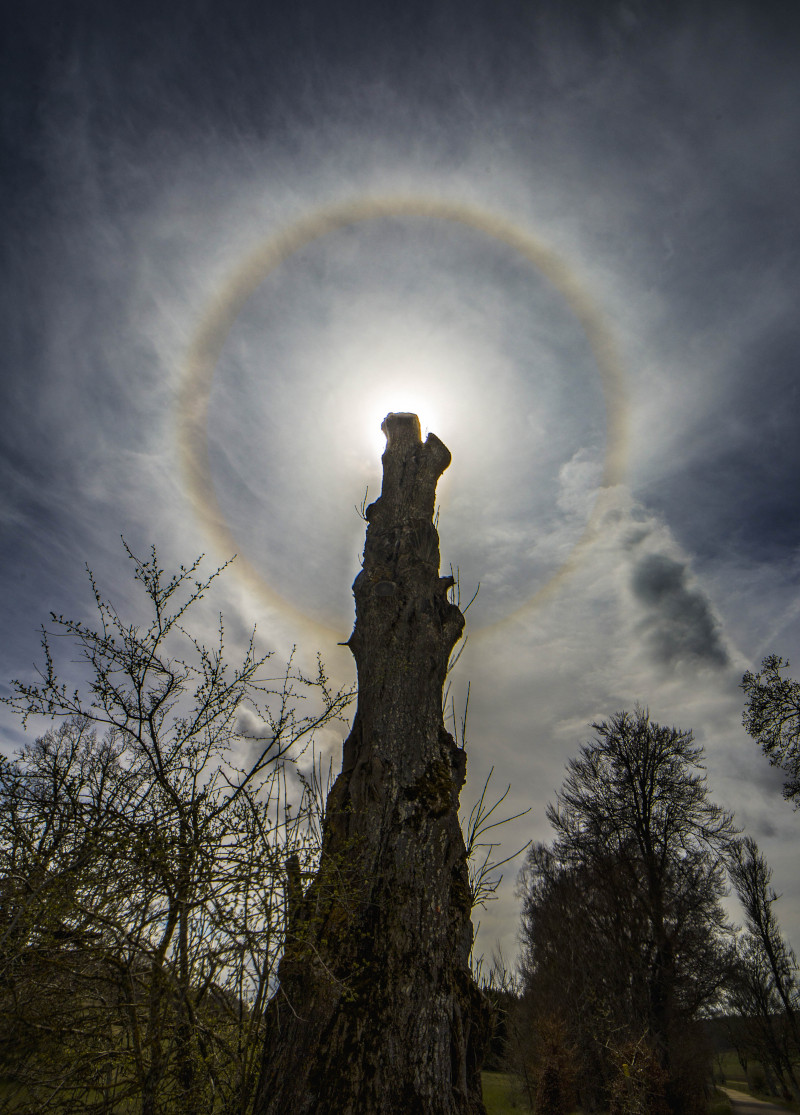
rth's orbit around the Sun is not a circle, it's an ellipse. The point along its elliptical orbit where our fair planet is closest to the Sun is called perihelion. This year, perihelion was on January 2 at 01:00 UTC, with the Earth about 3 million miles closer to the Sun than it was at aphelion (last July 6), the farthest point in its elliptical orbit. Of course, distance from the Sun doesn't determine the seasons, and it doesn't the determine size of Sun halos. Easier to see with the Sun hidden behind a tall tree trunk, this beautiful ice halo forms a 22 degree-wide circle around the Sun, recorded while strolling through the countryside near Heroldstatt, Germany. The Sun halo's 22 degree angular diameter is determined by the six-sided geometry of water ice crystals drifting high in planet Earth's atmosphere.