Perihelion
Perihelion is the point in the orbit of a planet or other celestial body where it is closest to the Sun. For Earth, perihelion occurs annually in early January, when the planet is about 147 million kilometers (91 million miles) from the Sun.
Source: ssd.jpl.nasa.gov
APODs including "Perihelion"
Structure in the Tail of Comet 12P/Pons-Brooks
16/02/2024
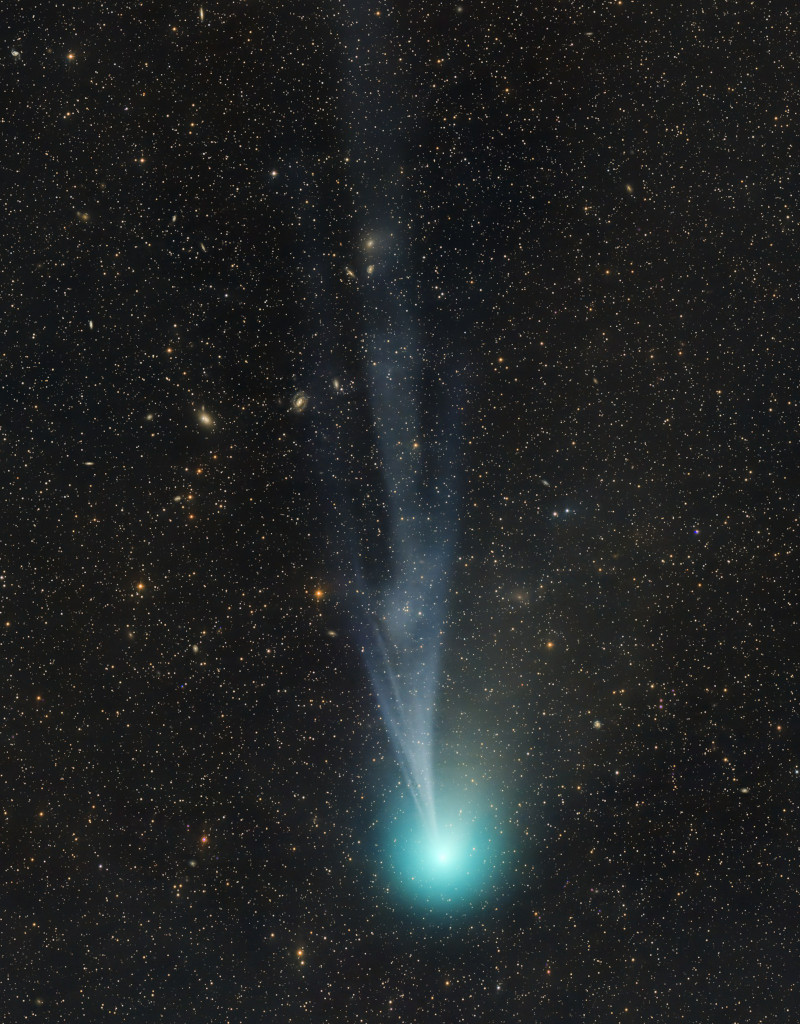
Heading for its next perihelion passage on April 21, Comet 12P/Pons-Brooks is growing brighter. The greenish coma of this periodic Halley-type comet has become relatively easy to observe in small telescopes. But the bluish ion tail now streaming from the active comet's coma and buffeted by the solar wind, is faint and difficult to follow. Still, in this image stacked exposures made on the night of February 11 reveal the fainter tail's detailed structures. The frame spans over two degrees across a background of faint stars and background galaxies toward the northern constellation Lacerta. Of course Comet 12P's April 21 perihelion passage will be only two weeks after the April 8 total solar eclipse, putting the comet in planet Earth's sky along with a totally eclipsed Sun.