Perihelion
Perihelion is the point in the orbit of a planet or other celestial body where it is closest to the Sun. For Earth, perihelion occurs annually in early January, when the planet is about 147 million kilometers (91 million miles) from the Sun.
Source: ssd.jpl.nasa.gov
APODs including "Perihelion"
Comet Pons-Brooks in Northern Spring
09/03/2024
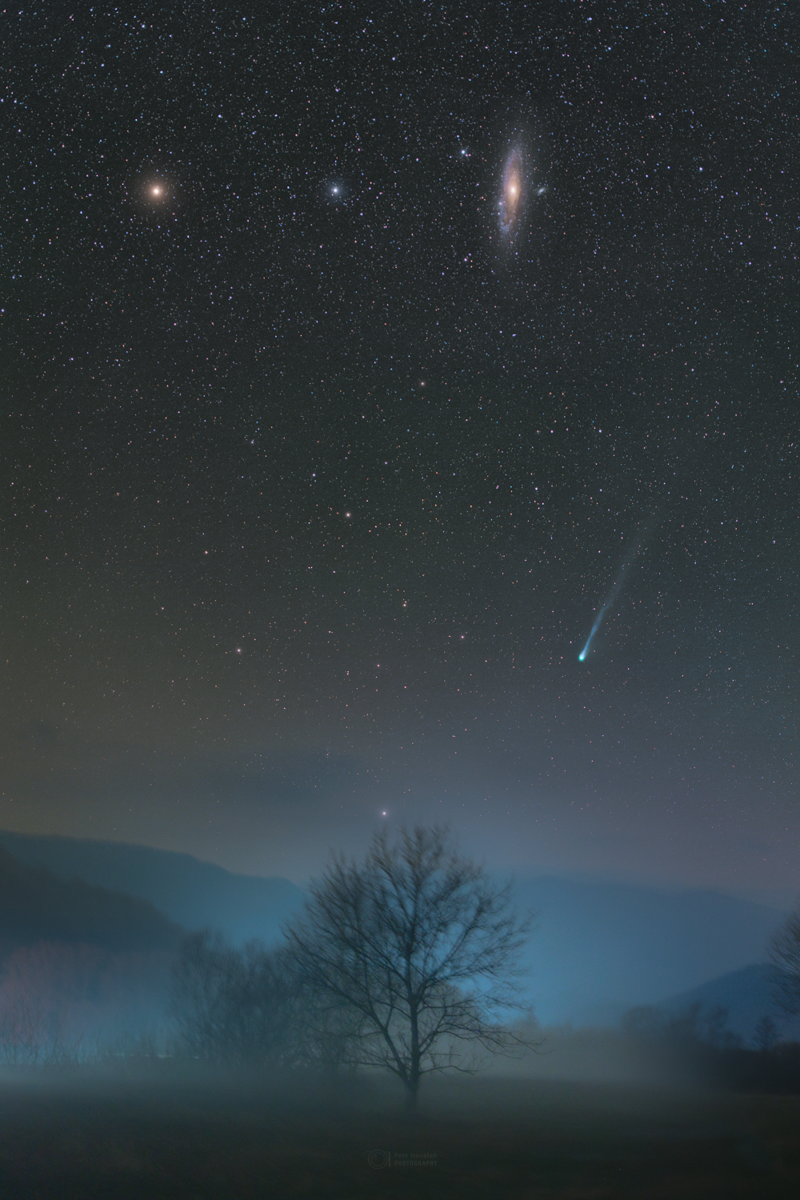
As spring approaches for northern skygazers, Comet 12P/Pons-Brooks is growing brighter. Currently visible with small telescopes and binoculars, the Halley-type comet could reach naked eye visibility in the coming weeks. Seen despite a foggy atmosphere, the comet's green coma and long tail hover near the horizon in this well-composed deep night skyscape from Revuca, Slovakia recorded on March 5. M31, also known as the Andromeda galaxy, and bright yellowish star Mirach, beta star of the constellation Andromeda, hang in the sky above the comet. The Andromeda galaxy is some 2.5 million light-years beyond the Milky Way. Comet Pons-Brooks is a periodic visitor to the inner Solar System and less than 14 light-minutes away. Reaching its perihelion on April 21, this comet should be visible in the sky during the April 8 total solar eclipse.