Perseid Meteor Shower
The Perseid Meteor Shower is a prolific annual meteor shower caused when Earth passes through the debris stream left by Comet 109P/Swift‑Tuttle. Active from mid‑July to late August, it peaks around August 12–13, producing up to ~50–100 meteors per hour under dark skies—many bright and fast enough to leave colorful wakes.
Source: science.nasa.gov
APODs including "Perseid Meteor Shower"
Meteors and Northern Lights
15/08/2002
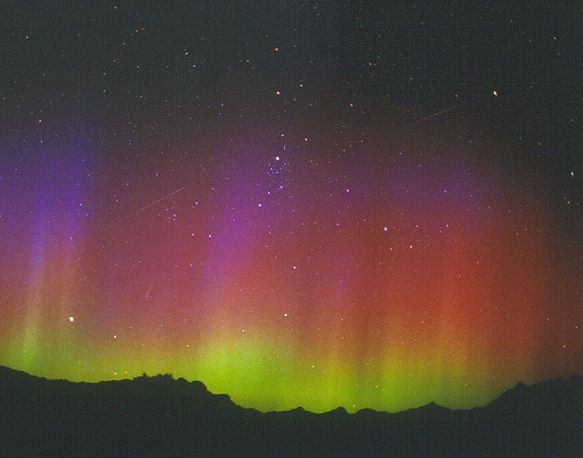
Skygazers report that the annual Perseid meteor shower went pretty much as predicted, producing a meteor every few minutes during the dark early morning hours of August 12 and 13. And as the constellation Perseus rose above the horizon on the night of August 11, astrophotographer Wade Clark was anticipating recording images of the flashing meteor trails from the Mt. Baker Ski Area in northwest Washington, USA. But Clark was also treated to a colorful display of northern lights. As a result, the stars of Perseus are arrayed near the center of his well composed skyscape along with trails of Perseid meteors all viewed through the auroral glow. The alluring scene might look familiar to watchers of bygone Perseids. For many, views of the meteor shower in 2000 also coincided with auroral displays, courtesy of the active Sun.