Perseid Meteor Shower
The Perseid Meteor Shower is a prolific annual meteor shower caused when Earth passes through the debris stream left by Comet 109P/Swift‑Tuttle. Active from mid‑July to late August, it peaks around August 12–13, producing up to ~50–100 meteors per hour under dark skies—many bright and fast enough to leave colorful wakes.
Source: science.nasa.gov
APODs including "Perseid Meteor Shower"
Rainbow Perseid
16/08/2002
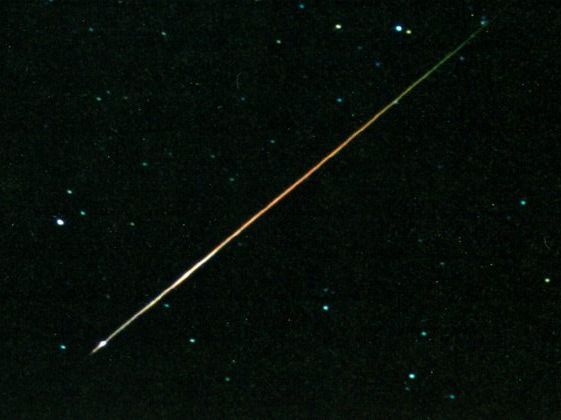
While meteors do show colors, the colors aren't always seen with the unaided eye. Still, high speed color film recorded this rainbow-like trail as a meteor streaked through the early morning sky on August 13 above Sedona, Arizona, USA. Part of the annual Perseid meteor shower, this bit of dust from the tail of Comet Swift-Tuttle entered Earth's atmosphere at over 200,000 kilometers per hour. The trail it left glowed briefly as friction with the atmosphere vaporized the dust grain and ionized atoms along its path. The initial green color is thought to be the glow from oxygen in the atmosphere at altitudes above 100 kilometers or so, while sodium atoms and other constituents of the cometary dust grain itself contribute to the orange hues.