Perseid Meteor Shower
The Perseid Meteor Shower is a prolific annual meteor shower caused when Earth passes through the debris stream left by Comet 109P/Swift‑Tuttle. Active from mid‑July to late August, it peaks around August 12–13, producing up to ~50–100 meteors per hour under dark skies—many bright and fast enough to leave colorful wakes.
Source: science.nasa.gov
APODs including "Perseid Meteor Shower"
A Perseid Aurora
09/08/2003
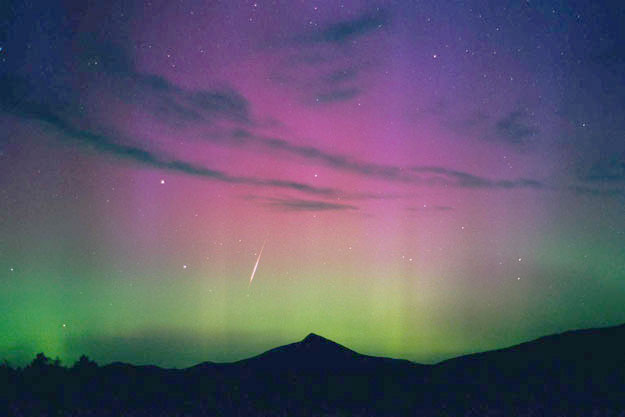
Just after the Moon set but before the Sun rose in the early morning hours of 2000 August 12, meteors pelted the Earth from the direction of the constellation Perseus, while ions pelted the Earth from the Sun. The meteors were expected as sub-sand grains long left behind by Comet Swift-Tuttle annually create the Perseids Meteor Shower. The aurorae were unexpected, however, as electrons, protons, and heavier ions raced out from a large Coronal Mass Ejection that had occurred just days before on the Sun. In the foreground is Hahn's Peak, an extinct volcano in Colorado, USA. The Perseid meteor shower peaks this year over the next few days, with as much as one bright meteor per minute visible from some locations.