Perseid Meteor Shower
The Perseid Meteor Shower is a prolific annual meteor shower caused when Earth passes through the debris stream left by Comet 109P/Swift‑Tuttle. Active from mid‑July to late August, it peaks around August 12–13, producing up to ~50–100 meteors per hour under dark skies—many bright and fast enough to leave colorful wakes.
Source: science.nasa.gov
APODs including "Perseid Meteor Shower"
Perseid Prelude
12/08/2010
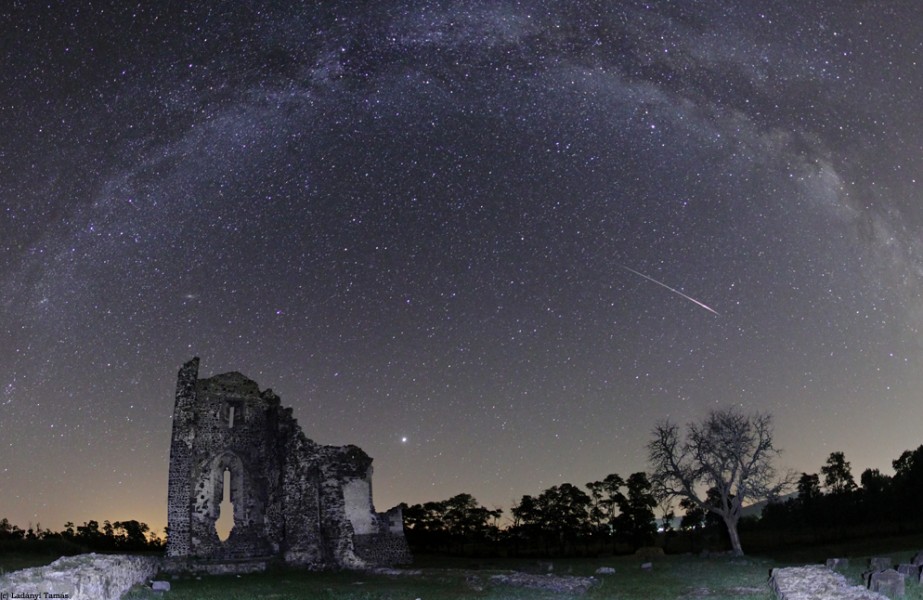
ch August, as planet Earth swings through dust trailing along the orbit of periodic comet Swift-Tuttle, skygazers can enjoy the Perseid Meteor Shower. The shower should build to its peak now, best seen from later tonight after moonset, until dawn tomorrow morning when Earth moves through the denser part of the wide dust trail. But shower meteors have been spotted for many days, like this bright Perseid streaking through skies near Lake Balaton, Hungary on August 8. In the foreground is the region's Church of St. Andrew ruin, with bright Jupiter dominating the sky to its right. Two galaxies lie in the background of the wide-angle, 3 frame panorama; our own Milky Way's luminous arc, and the faint smudge of the more distant Andromeda Galaxy just above the ruin's leftmost wall. If you watch for Perseid meteors tonight, be sure and check out the early evening sky show too, featuring bright planets and a young crescent Moon near the western horizon after sunset.