Perseid Meteor Shower
The Perseid Meteor Shower is a prolific annual meteor shower caused when Earth passes through the debris stream left by Comet 109P/Swift‑Tuttle. Active from mid‑July to late August, it peaks around August 12–13, producing up to ~50–100 meteors per hour under dark skies—many bright and fast enough to leave colorful wakes.
Source: science.nasa.gov
APODs including "Perseid Meteor Shower"
The Perseids and the Plough
15/08/2019
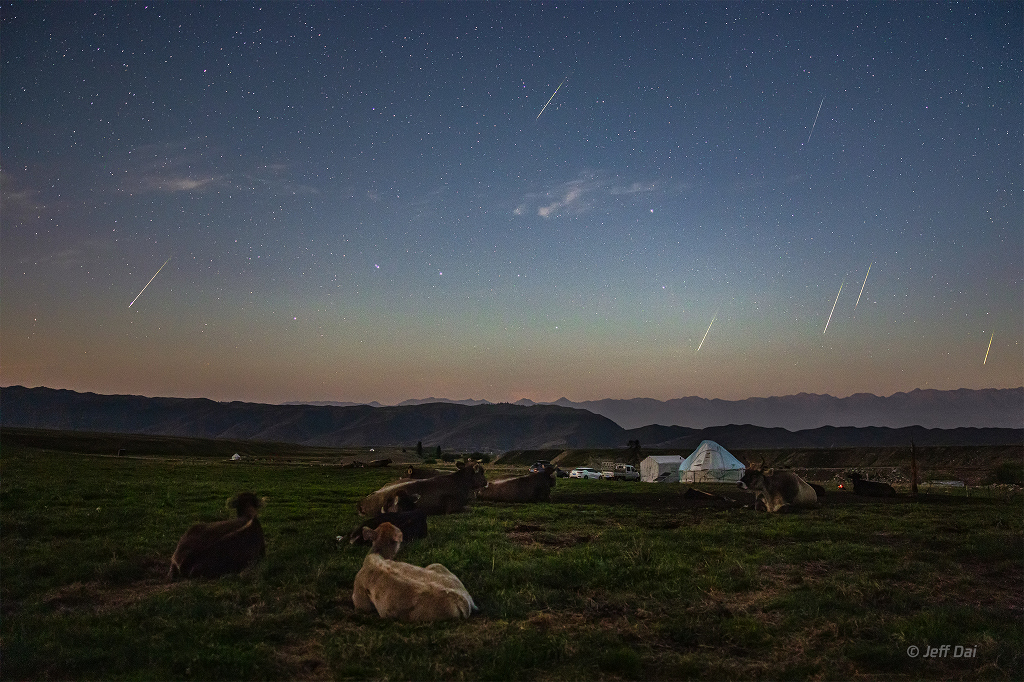
Despite interfering moonlight, many denizens of planet Earth were able to watch this year's Perseid meteor shower. This pastoral scene includes local skygazers admiring the shower's brief, heavenly flashes in predawn hours near peak activity on August 13 from Nalati Grassland in Xinjiang, China. A composite, the image registers seven frames taken during a two hour span recording Perseid meteor streaks against a starry sky. Centered along the horizon is the Plough, the north's most famous asterism, though some might see the familiar celestial kitchen utensil known as the Big Dipper. Perhaps the year's most easily enjoyed meteor shower, Perseid meteors are produced as Earth itself sweeps through dust from periodic comet Swift-Tuttle. The dust particles are vaporized at altitudes of 100 kilometers or so as they plow through the atmosphere at 60 kilometers per second.