Perseid Meteor Shower
The Perseid Meteor Shower is a prolific annual meteor shower caused when Earth passes through the debris stream left by Comet 109P/Swift‑Tuttle. Active from mid‑July to late August, it peaks around August 12–13, producing up to ~50–100 meteors per hour under dark skies—many bright and fast enough to leave colorful wakes.
Source: science.nasa.gov
APODs including "Perseid Meteor Shower"
Perseus and the Lost Meteors
09/08/2021
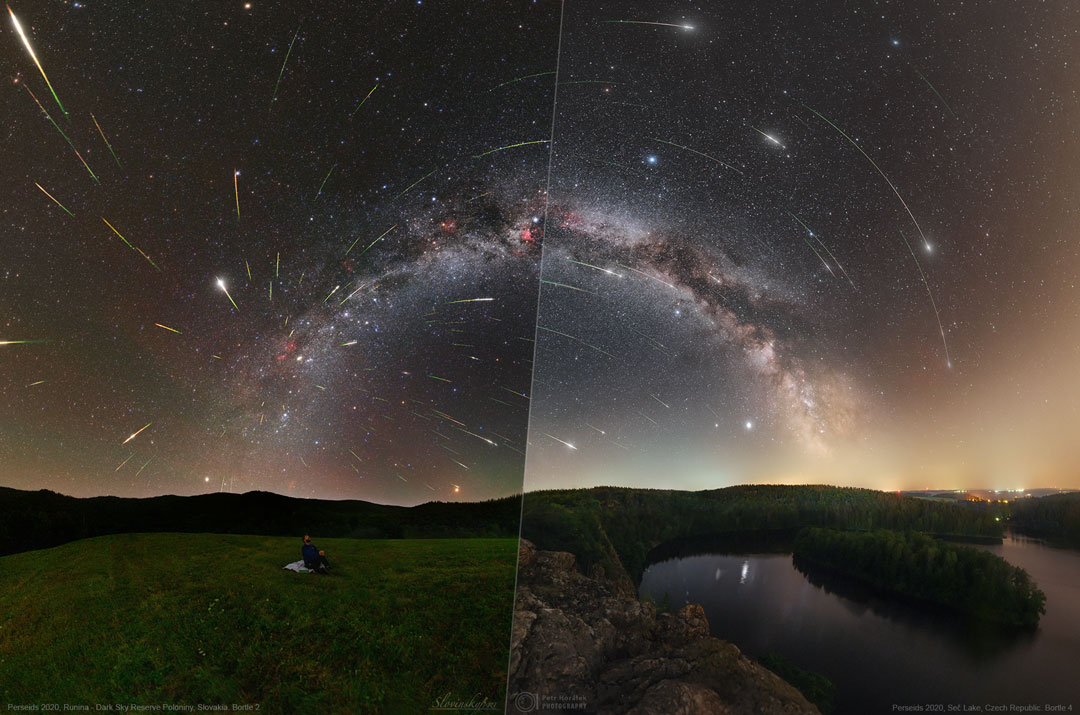
What's the best way to watch a meteor shower? This question might come up later this week when the annual Perseid Meteor Shower peaks. One thing that is helpful is a dark sky, as demonstrated in the featured composite image of last year's Perseids. Many more faint meteors are visible on the left image, taken through a very dark sky in Slovakia, than on the right image, taken through a moderately dark sky in the Czech Republic. The band of the Milky Way Galaxy bridges the two coordinated images, while the meteor shower radiant in the constellation of Perseus is clearly visible on the left. In sum, many faint meteors are lost through a bright sky. Light pollution is shrinking areas across our Earth with dark skies, although inexpensive ways to combat this might be implemented. Notable Perseids Submissions to APOD: 2018, 2019, 2020