Perseid Meteor Shower
The Perseid Meteor Shower is a prolific annual meteor shower caused when Earth passes through the debris stream left by Comet 109P/Swift‑Tuttle. Active from mid‑July to late August, it peaks around August 12–13, producing up to ~50–100 meteors per hour under dark skies—many bright and fast enough to leave colorful wakes.
Source: science.nasa.gov
APODs including "Perseid Meteor Shower"
Perseid Rain
15/08/2021
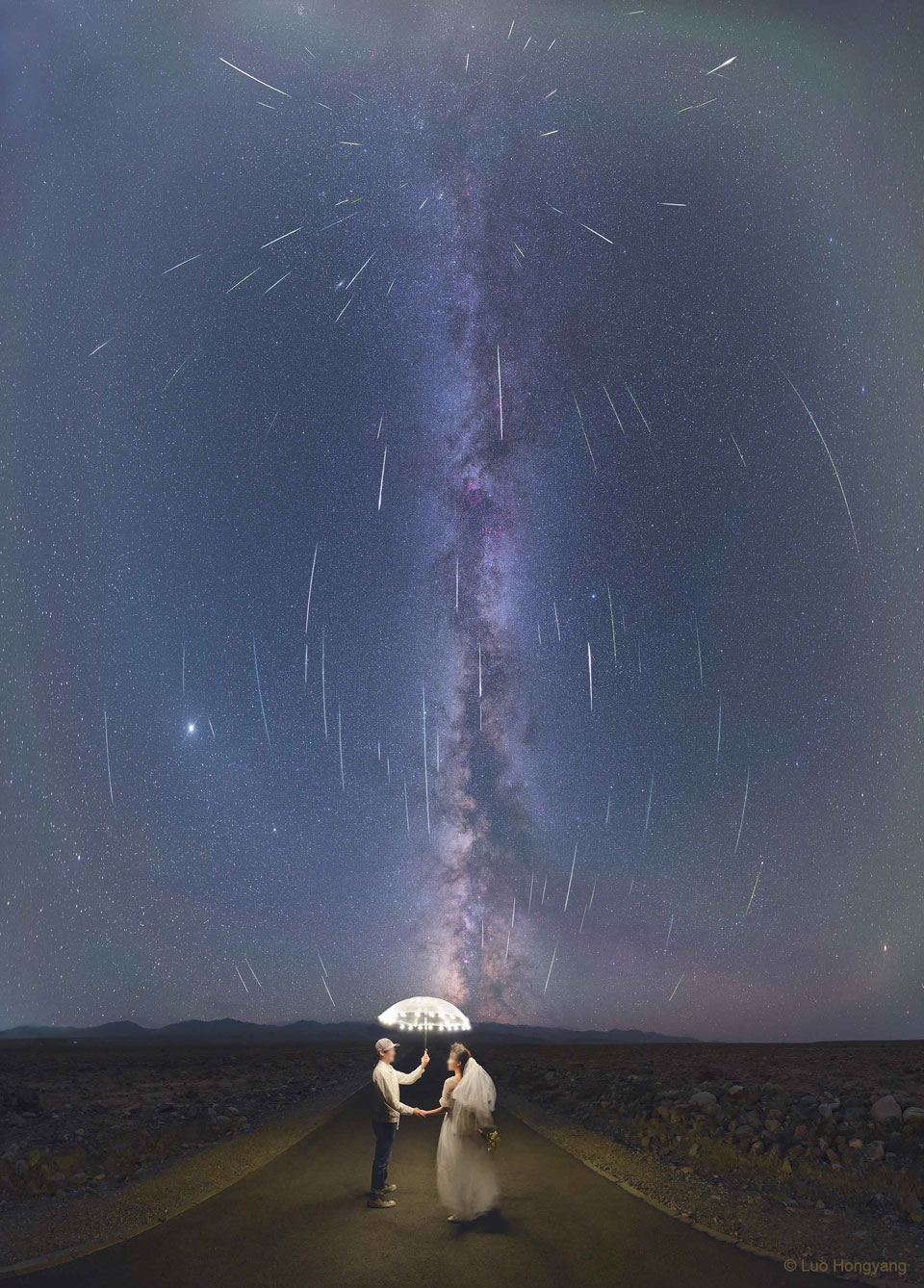
Comet dust rained down on planet Earth last week, streaking through dark skies in the annual Perseid meteor shower. The featured picture is a composite of many images taken from the same location over the peak night of the Perseids. The umbrella was not needed as a shield from meteors, since they almost entirely evaporate high in the Earth's atmosphere. Many of the component images featured individual Perseids, while one image featured the foreground near Jiuquan City, Gansu Province, China. The stellar background includes the central band of our Milky Way Galaxy, appearing nearly vertical, as well as the planets Jupiter and Saturn on the left. Although the comet dust particles are traveling parallel to each other, the resulting shower meteors clearly seem to radiate from a single point on the sky -- the radiant in the eponymous constellation Perseus. The image captured so long an angular field that the curvature of the sky is visible in the trajectory of the Perseids. Notable APOD Image Submissions: Perseid Meteor Shower 2021