Perseid Meteor Shower
The Perseid Meteor Shower is a prolific annual meteor shower caused when Earth passes through the debris stream left by Comet 109P/Swift‑Tuttle. Active from mid‑July to late August, it peaks around August 12–13, producing up to ~50–100 meteors per hour under dark skies—many bright and fast enough to leave colorful wakes.
Source: science.nasa.gov
APODs including "Perseid Meteor Shower"
The Light, Dark, and Dusty Trifid
10/08/2024
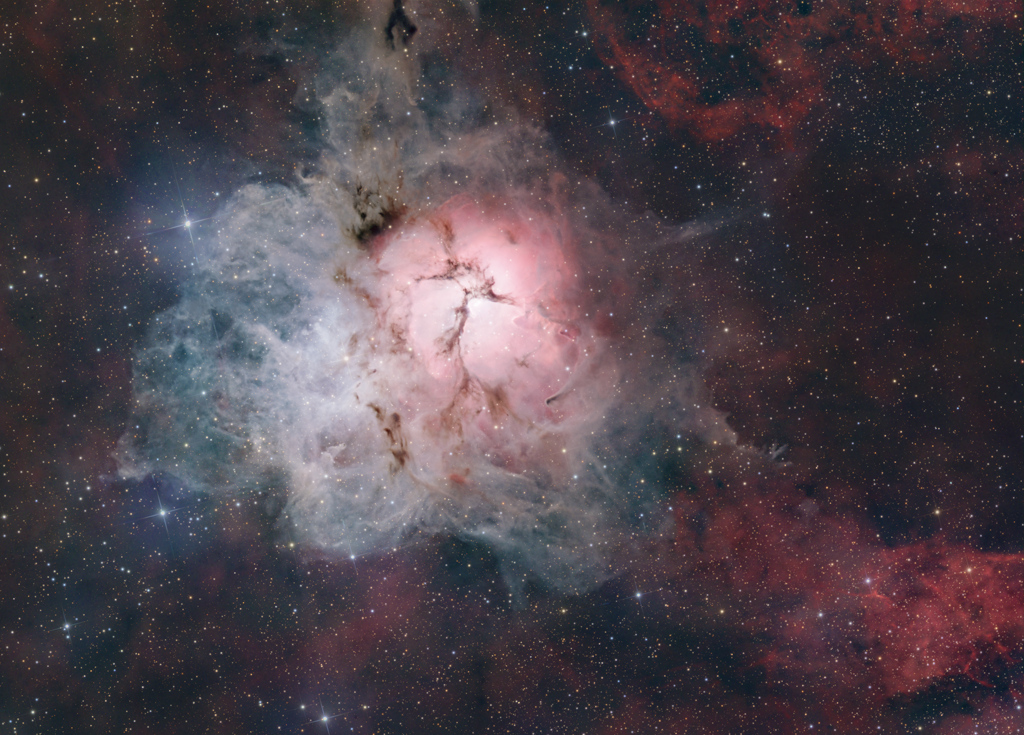
Messier 20, popularly known as the Trifid Nebula, lies about 5,000 light-years away toward the nebula rich constellation Sagittarius. A star forming region in the plane of our galaxy, the Trifid does illustrate three different types of astronomical nebulae; red emission nebulae dominated by light from hydrogen atoms, blue reflection nebulae produced by dust reflecting starlight, and dark nebulae where dense dust clouds appear in silhouette. The reddish emission region, roughly separated into three parts by obscuring dust lanes, is what lends the Trifid its popular name. The cosmic cloud complex is over 40 light-years across and would cover the area of a full moon on planet Earth's sky. But the Trifid Nebula is too faint to be seen by the unaided eye. Over 75 hours of image data captured under dark night skies was used to create this stunning telescopic view. Watch: The Perseid Meteor Shower