Perseid Meteor Shower
The Perseid Meteor Shower is a prolific annual meteor shower caused when Earth passes through the debris stream left by Comet 109P/Swift‑Tuttle. Active from mid‑July to late August, it peaks around August 12–13, producing up to ~50–100 meteors per hour under dark skies—many bright and fast enough to leave colorful wakes.
Source: science.nasa.gov
APODs including "Perseid Meteor Shower"
Meteors and Aurora over Germany
14/08/2024
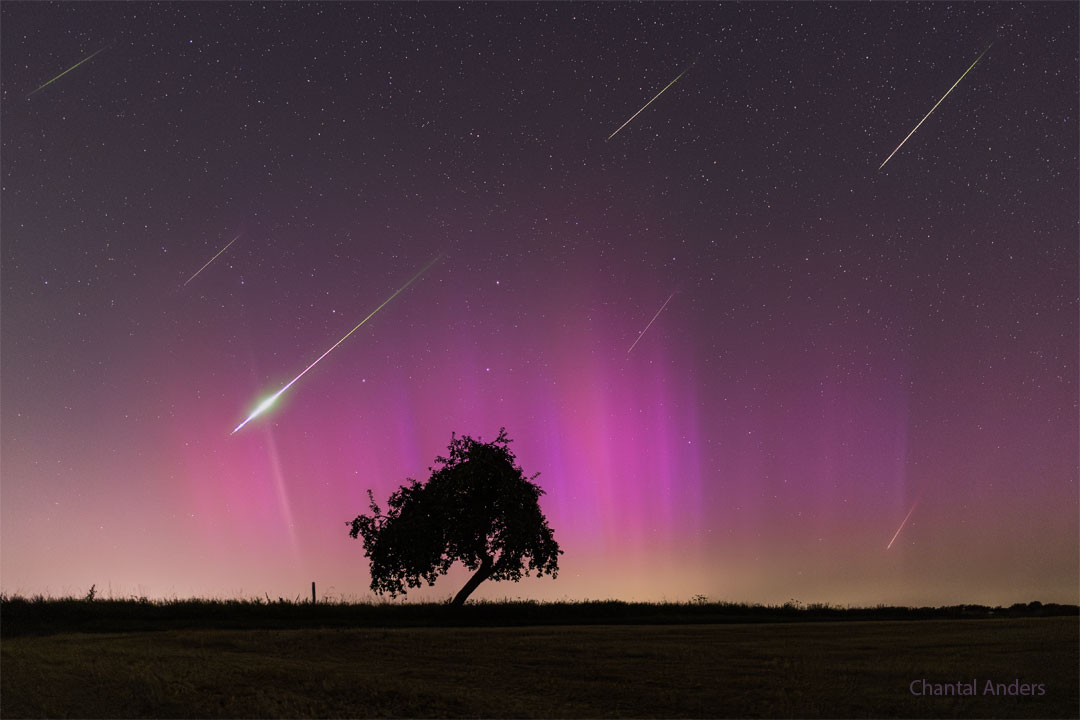
This was an unusual night. For one thing, the night sky of August 11 and 12, earlier this week, occurred near the peak of the annual Perseid Meteor Shower. Therefore, meteors streaked across the dark night as small bits cast off from Comet Swift-Tuttle came crashing into the Earth's atmosphere. Even more unusually, for central Germany at least, the night sky glowed purple. The red-blue hue was due to aurora caused by an explosion of particles from the Sun a few days before. This auroral storm was so intense that it was seen as far south as Texas and Italy, in Earth's northern hemisphere. The featured image composite was built from 7 exposures taken over 26 minutes from Ense, Germany. The Perseids occur predictably every August, but auroras visible this far south are more unusual and less predictable. Gallery: Perseid Meteor Shower 2024 and Aurorae