Planetary Nebula
An expanding shell of ionized gas ejected from a red giant star in the late stages of stellar evolution. Despite the name, it has no connection to planets. The glowing gas is illuminated by the hot core of the dying star.
Source: science.nasa.gov
APODs including "Planetary Nebula"
M57: The Ring Nebula
27/07/1995
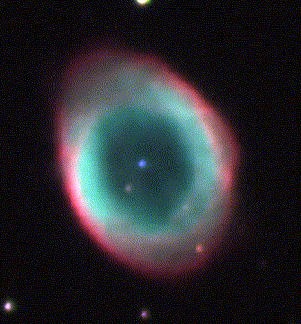
July 27, 1995 M57: The Ring Nebula Credit: The Electronic Universe Project, Nelson Caldwell Explanation: A star with mass similar to that of our Sun will throw off its outer gasses after fusion has stopped in its core. Possibly the most visually spectacular of these planetary nebula is the pictured Ring Nebula. The appearance as a ring is really an illusion of projection - the nebula is actually a spherical shell. At the center a blue dot is visible which is the old core of the star, known as a white dwarf. It is still not known exactly how the star throws off the gas that becomes the nebula. For more information on the Ring Nebula see The Electronic Universe Project's write-up. Many images of Messier objects can be found in The Electronic Universe Project's The Galaxy Gallery: Messier Objects.