Planetary Nebula
An expanding shell of ionized gas ejected from a red giant star in the late stages of stellar evolution. Despite the name, it has no connection to planets. The glowing gas is illuminated by the hot core of the dying star.
Source: science.nasa.gov
APODs including "Planetary Nebula"
NGC 7293: The Helix Nebula
17/04/1996
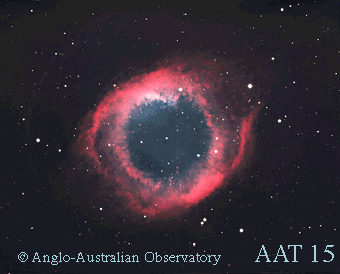
The Helix nebula (New General Catalog number 7293) is estimated to be a mere 450 light-years from the Sun, in the direction of the constellation Aquarius. At that distance it may well be the closest planetary nebula, offering a dramatic snapshot of a brief final evolutionary stage in the life of a solar-type star. In this color image the nebula glows red in the light of nitrogen and hydrogen atoms energized by the ultraviolet radiation from the central star. The main rings themselves, though faint, have an angular size about half that of the full moon and span about 1.5 light-years. Because it is so close, it is a prime subject for study by astronomers. When the Hubble Space Telescope was focused near the inner edge of the main ring, at about the 12 o'clock position in the above image, it resolved some of the spoke like radial structures visible into intriguing cometary knots. Information: The Scale of the Universe Debate in April 1996