Planetary Nebula
An expanding shell of ionized gas ejected from a red giant star in the late stages of stellar evolution. Despite the name, it has no connection to planets. The glowing gas is illuminated by the hot core of the dying star.
Source: science.nasa.gov
APODs including "Planetary Nebula"
At the Edge of the Helix
20/07/1997
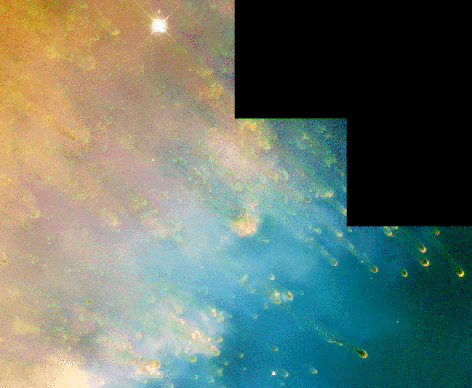
While exploring the inner edge of the Helix Nebula with the Hubble Space Telescope's Wide Field Planetary Camera 2, astronomers were able to produce this striking image - rich in details of an exotic environment. This planetary nebula, created near the final phase of a sun-like star's life, is composed of tenuous shells of gas ejected by the hot central star. The atoms of gas, stripped of electrons by ultraviolet radiation from the central star, radiate light at characteristic energies allowing specific chemical elements to be identified. In this image, emission from nitrogen is represented as red, hydrogen emission as green, and oxygen as blue. The inner edge of the nebula (the direction to the central star) is toward the bottom right. Clearly visible close to the inner edge are finger shaped "cometary knots".