Planetary Nebula
An expanding shell of ionized gas ejected from a red giant star in the late stages of stellar evolution. Despite the name, it has no connection to planets. The glowing gas is illuminated by the hot core of the dying star.
Source: science.nasa.gov
APODs including "Planetary Nebula"
NGC 5307: A Symmetric Planetary Nebula
31/12/1997
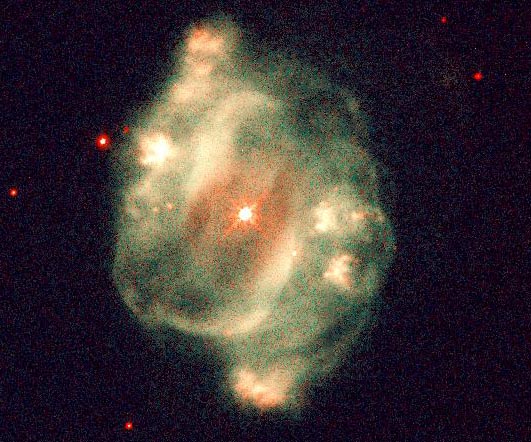
Some stellar nebulae are strangely symmetric. For example, every major blob of gas visible on the upper left of NGC 5307 appears to have a counterpart on the lower right. This picture taken by the Hubble Space Telescope was released last week. NGC 5307 is an example of a planetary nebula with a spiral shape. Spiral planetary nebulae are thought to be caused by a bright central white dwarf star expelling a symmetric wobbling jet of rapidly moving gas. It takes light about 10,000 years to reach us from NGC 5307, and about 6 months just to go from one side to the other. In contrast, light takes only about 8 minutes to reach Earth from the Sun.