Planetary Nebula
An expanding shell of ionized gas ejected from a red giant star in the late stages of stellar evolution. Despite the name, it has no connection to planets. The glowing gas is illuminated by the hot core of the dying star.
Source: science.nasa.gov
APODs including "Planetary Nebula"
The Hubble 5 Planetary Nebula
19/01/1998
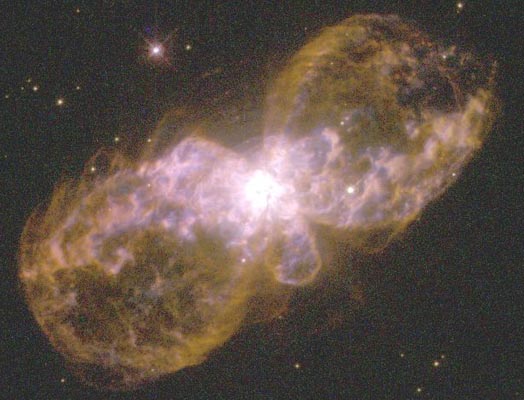
The Hubble Double Bubble Planetary Nebula is bubbling over with excitement. More mundanely known as Hubble 5, this bipolar planetary nebula is being created by a hot wind of particles streaming away from the central star system. The hot gas expands into the surrounding interstellar medium in a fashion similar to the inflation of hot air balloons. A supersonic shock-wave can form at the boundary, causing newly excited gas there to shine as electrons recombine with resident elements. In the above picture, colors are assigned according to the energy of the recombinant radiation. This star system lies about 2200 light-years from Earth, and likely includes a Sun-like star slowly transforming itself into a white dwarf.