Planetary Nebula
An expanding shell of ionized gas ejected from a red giant star in the late stages of stellar evolution. Despite the name, it has no connection to planets. The glowing gas is illuminated by the hot core of the dying star.
Source: science.nasa.gov
APODs including "Planetary Nebula"
Planetary Nebula NGC 7027 in Infrared
25/03/1998
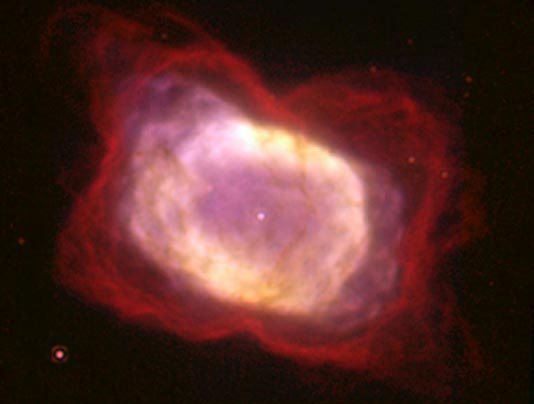
NGC 7027 is one of the smallest known planetary nebulae. Even so, NGC 7027 is 14,000 times larger than the Earth-Sun distance. Planetary nebula are so named because the first few discovered appeared similar to planets. Planetary nebula are actually dying stars, though, that have recently run out of nuclear fuel. The outer gaseous shells are expelled by an unknown process, frequently creating spectacular displays. In the above picture in infrared light, the hot central star is visible. Our Sun will become a planetary nebula in about 5 billion years.