Planetary Nebula
An expanding shell of ionized gas ejected from a red giant star in the late stages of stellar evolution. Despite the name, it has no connection to planets. The glowing gas is illuminated by the hot core of the dying star.
Source: science.nasa.gov
APODs including "Planetary Nebula"
Hen-1357: New Born Nebula
03/04/1998
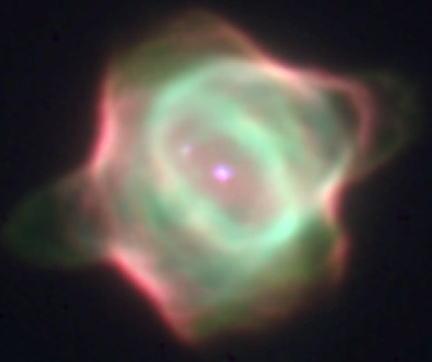
This Hubble Space Telescope picture shows Hen-1357, the youngest known planetary nebula. Graceful, gentle curves and symmetry suggest its popular name - The Stingray Nebula. Observations in the 1970s detected no nebular material, but this image from March 1996 clearly shows the Stingray's emerging bubbles and rings of shocked and ionized gas. The gas is energized by the hot central star as it nears the end of its life, evolving toward a final white dwarf phase. The image also shows a companion star (at about 10 o'clock) within the nebula. Astronomers suspect that such companions account for the complex shapes and rings of this and many other planetary nebulae. This cosmic infant is about 130 times the size of our own solar system and growing. It is 18,000 light-years distant, in the southern constellation Ara.