Planetary Nebula
An expanding shell of ionized gas ejected from a red giant star in the late stages of stellar evolution. Despite the name, it has no connection to planets. The glowing gas is illuminated by the hot core of the dying star.
Source: science.nasa.gov
APODs including "Planetary Nebula"
M27: Not A Comet
09/10/1998
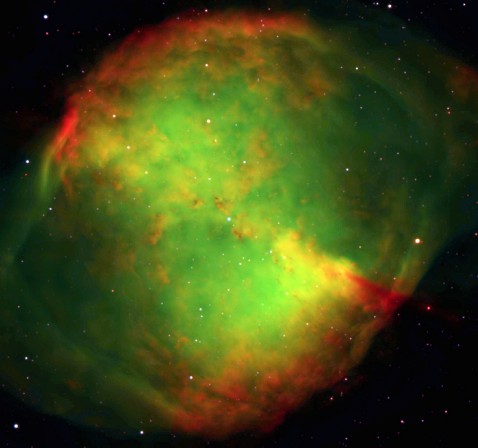
While searching the skies above 18th century France for comets, astronomer Charles Messier diligently recorded this object as number 27 on his list of things which are definitely not comets. So what is it? Well, 20th century astronomers would classify it as a Planetary Nebula ... but it's not a planet either, even though it may appear round and planet-like in a small telescope. Messier 27 (M27) is now known to be an excellent example of a gaseous emission nebula created as a sun-like star runs out of nuclear fuel in its core. The nebula forms as the star's outer layers are expelled into space, with a visible glow generated by atoms excited by the dying star's intense but invisible ultraviolet light. Known by the popular name of the "Dumbbell Nebula", the beautifully symmetric interstellar gas cloud is about 1,200 light-years away in the constellation Vulpecula. This gorgeous synthetic color picture of M27 was produced during testing of the European Southern Observatory's new Very Large Telescope.