Planetary Nebula
An expanding shell of ionized gas ejected from a red giant star in the late stages of stellar evolution. Despite the name, it has no connection to planets. The glowing gas is illuminated by the hot core of the dying star.
Source: science.nasa.gov
APODs including "Planetary Nebula"
Dumbbell Nebula Halo
25/07/2003
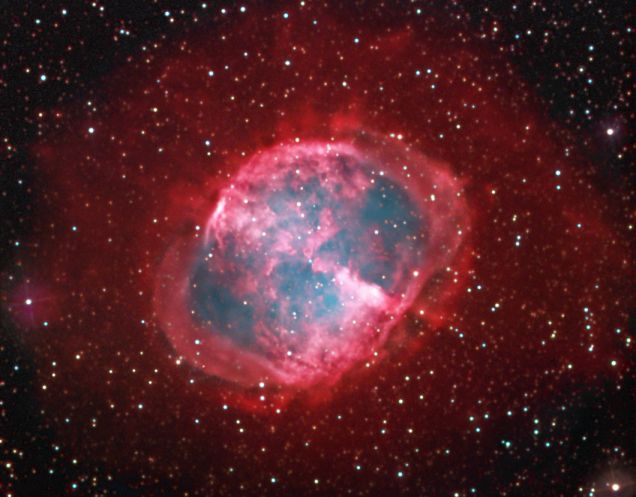
In 1764, French astronomer Charles Messier sighted this gorgeous cosmic cloud which he described as an oval nebula without stars. Cataloged as M27, it is now popularly known as the Dumbbell Nebula, not for its substandard academic performance but for the elongated shape, like a bar with weights on each end, which first caught Messier's eye. This deep image of the bright planetary nebula does reveal the Dumbell's central star though, and an array of foreground and background stars toward the sly constellation Vulpecula. The picture is a composite that includes 8 hours of exposure through a filter designed to record only the light of hydrogen atoms, tracing the intricate details of the nebula's faint outer halo which spans light-years. Thought to be an example of the fate awaiting our own Sun 5 billion years hence, the Dumbbell Nebula is about 1,200 light-years away.