Planetary Nebula
An expanding shell of ionized gas ejected from a red giant star in the late stages of stellar evolution. Despite the name, it has no connection to planets. The glowing gas is illuminated by the hot core of the dying star.
Source: science.nasa.gov
APODs including "Planetary Nebula"
M97: The Owl Nebula
15/05/2009
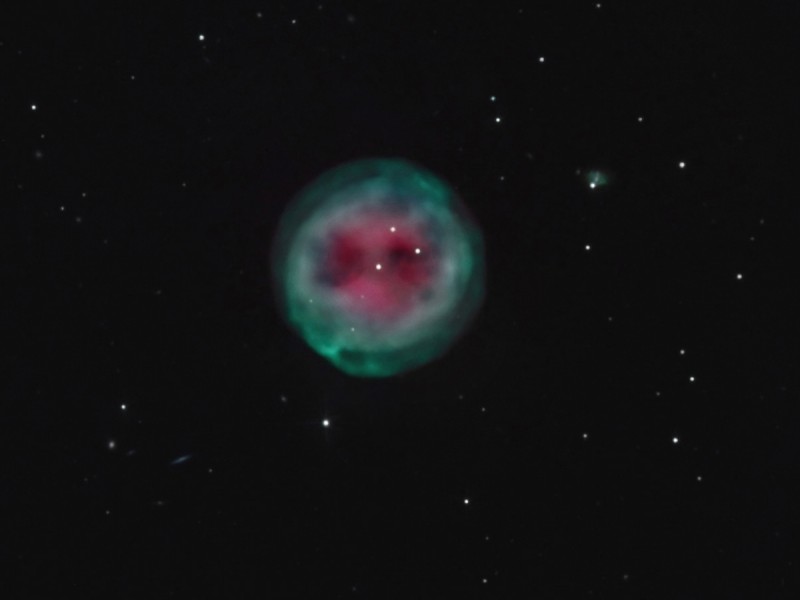
The Owl Nebula is perched in the sky about 2,600 light-years away toward the bottom of the Big Dipper's bowl. Also cataloged as M97, the 97th object in Messier's well-known list, its round shape along with the placement of two large, dark "eyes" do suggest the face of a staring owl. One of the fainter objects in Messier's catalog, the Owl Nebula is a planetary nebula, the glowing gaseous envelope shed by a dying sun-like star as it runs out of nuclear fuel. In fact, the Owl Nebula offers an example of the fate of our Sun as it runs out of fuel in another 5 billion years. As we see it, the nebula spans over 2 light-years making it roughly 2,000 times the diameter of Neptune's orbit. Beautiful to look at, this color image shows impressive details within the cosmic owl. The composite includes images made through narrow-band filters for a total of 24 hours of exposure time.