Planetary Nebula
An expanding shell of ionized gas ejected from a red giant star in the late stages of stellar evolution. Despite the name, it has no connection to planets. The glowing gas is illuminated by the hot core of the dying star.
Source: science.nasa.gov
APODs including "Planetary Nebula"
Methuselah Nebula MWP1
21/10/2010
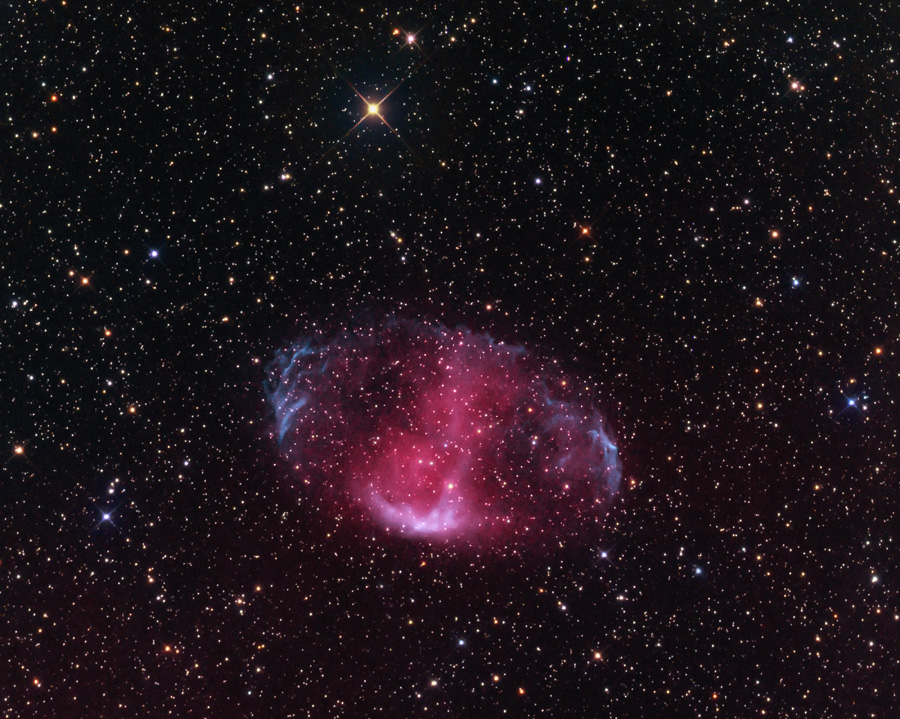
The lovely, symmetric planetary nebula cataloged as MWP1 lies some 4,500 light-years away in the northern constellation Cygnus the Swan. One of the largest planetary nebulae known, it spans about 15 light-years. Based on its expansion rate the nebula has an age of 150 thousand years, a cosmic blink of an eye in the 10 billion year life of a sun-like star. But planetary nebulae represent a very brief final phase in stellar evolution, as the nebula's central star shrugs off its outer layers to become a hot white dwarf. In fact, planetary nebulae ordinarily only last for 10 to 20 thousand years. As a result, truly ancient MWP1 offers a beautiful challenge to astronomers studying the evolution of its central star.