Planetary Nebula
An expanding shell of ionized gas ejected from a red giant star in the late stages of stellar evolution. Despite the name, it has no connection to planets. The glowing gas is illuminated by the hot core of the dying star.
Source: science.nasa.gov
APODs including "Planetary Nebula"
NGC 7293: The Helix Nebula
08/01/2011
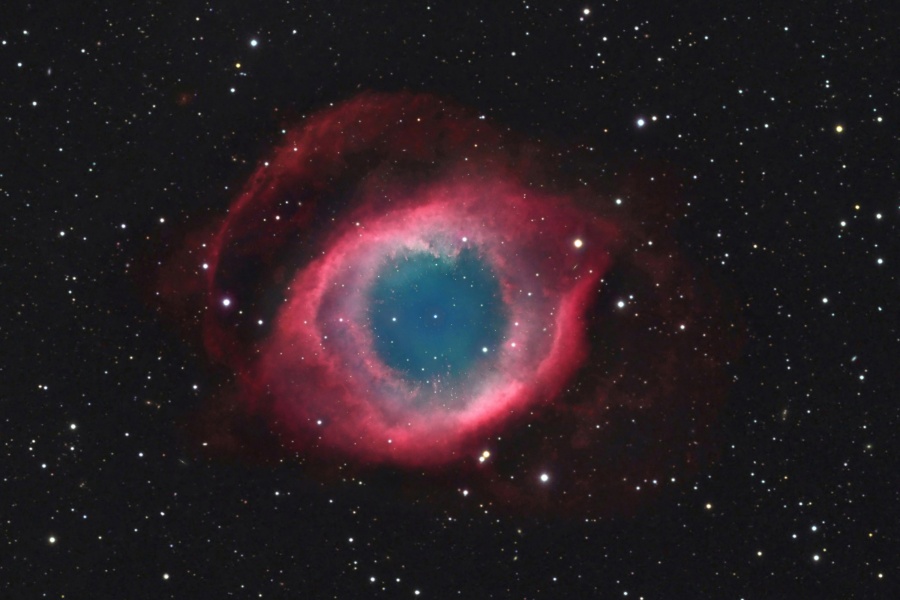
A mere seven hundred light years from Earth, in the constellation Aquarius, a sun-like star is dying. Its last few thousand years have produced the Helix Nebula (NGC 7293), a well studied and nearby example of a Planetary Nebula, typical of this final phase of stellar evolution. A total of 10 hours of exposure time have gone in to creating this remarkably deep view of the nebula. It shows details of the Helix's brighter inner region, about 3 light-years across, but also follows fainter outer halo features that give the nebula a span of well over six light-years. The white dot at the Helix's center is this Planetary Nebula's hot, central star. A simple looking nebula at first glance, the Helix is now understood to have a surprisingly complex geometry.