Planetary Nebula
An expanding shell of ionized gas ejected from a red giant star in the late stages of stellar evolution. Despite the name, it has no connection to planets. The glowing gas is illuminated by the hot core of the dying star.
Source: science.nasa.gov
APODs including "Planetary Nebula"
Spherical Planetary Nebula Abell 39
08/10/2012
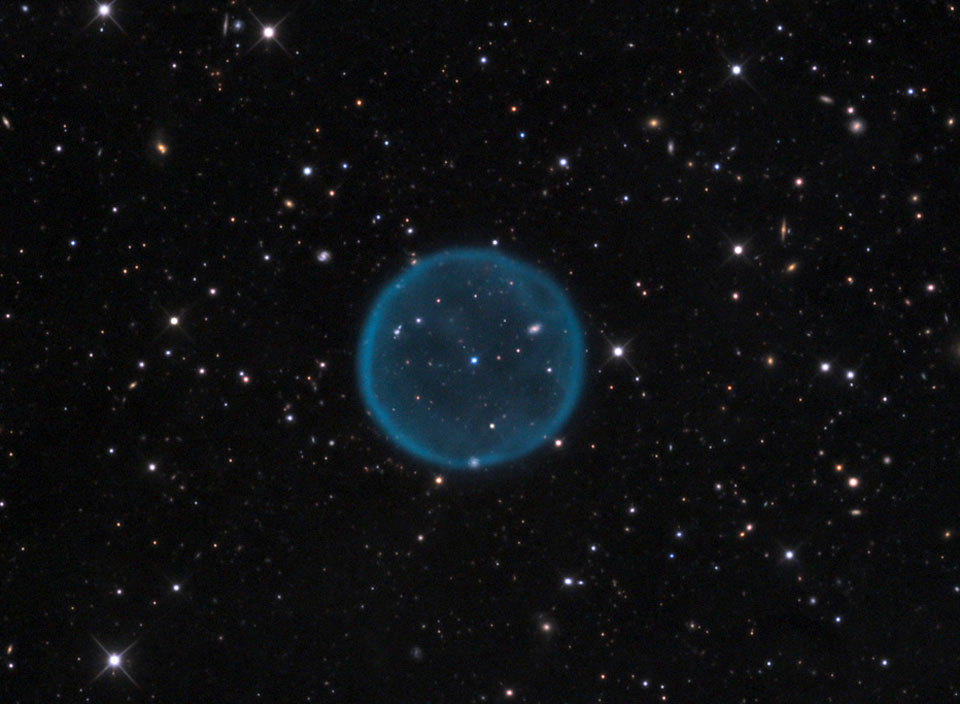
Ghostly in appearance, Abell 39 is a remarkably simple, spherical nebula about five light-years across. Well within our own Milky Way galaxy, the cosmic sphere is roughly 7,000 light-years distant toward the constellation Hercules. Abell 39 is a planetary nebula, formed as a once sun-like star's outer atmosphere was expelled over a period of thousands of years. Still visible, the nebula's central star is evolving into a hot white dwarf. Although faint, the nebula's simple geometry has proven to be a boon to astronomers exploring the chemical abundances and life cycles of stars. In this deep image recorded under dark night skies, very distant background galaxies can be found -- some visible right through the nebula itself.