Planetary Nebula
An expanding shell of ionized gas ejected from a red giant star in the late stages of stellar evolution. Despite the name, it has no connection to planets. The glowing gas is illuminated by the hot core of the dying star.
Source: science.nasa.gov
APODs including "Planetary Nebula"
M57: The Ring Nebula
05/06/2013
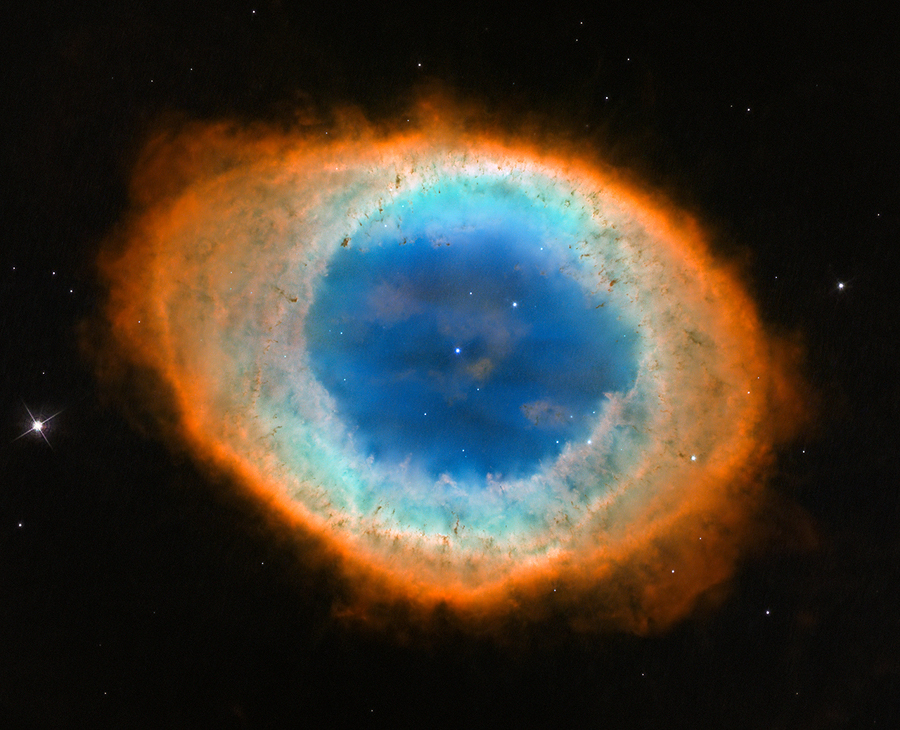
cept for the rings of Saturn, the Ring Nebula (M57) is probably the most famous celestial band. Its classic appearance is understood to be due to our own perspective, though. The recent mapping of the expanding nebula's 3-D structure, based in part on this clear Hubble image, indicates that the nebula is a relatively dense, donut-like ring wrapped around the middle of a football-shaped cloud of glowing gas. The view from planet Earth looks down the long axis of the football, face-on to the ring. Of course, in this well-studied example of a planetary nebula, the glowing material does not come from planets. Instead, the gaseous shroud represents outer layers expelled from the dying, once sun-like star, now a tiny pinprick of light seen at the nebula's center. Intense ultraviolet light from the hot central star ionizes atoms in the gas. In the picture, the blue color in the center is ionized helium, the cyan color of the inner ring is the glow of hydrogen and oxygen, and the reddish color of the outer ring is from nitrogen and sulfur. The Ring Nebula is about one light-year across and 2,000 light-years away.