Planetary Nebula
An expanding shell of ionized gas ejected from a red giant star in the late stages of stellar evolution. Despite the name, it has no connection to planets. The glowing gas is illuminated by the hot core of the dying star.
Source: science.nasa.gov
APODs including "Planetary Nebula"
The Cat's Eye Nebula from Hubble
09/11/2014
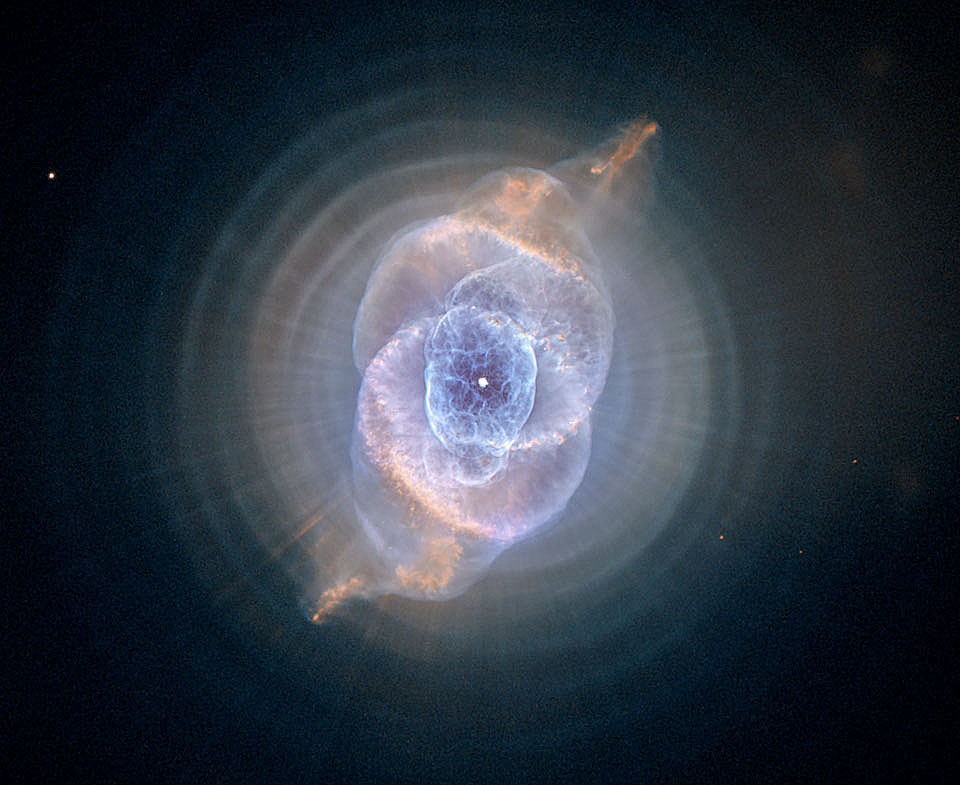
To some, it may look like a cat's eye. The alluring Cat's Eye nebula, however, lies three thousand light-years from Earth across interstellar space. A classic planetary nebula, the Cat's Eye (NGC 6543) represents a final, brief yet glorious phase in the life of a sun-like star. This nebula's dying central star may have produced the simple, outer pattern of dusty concentric shells by shrugging off outer layers in a series of regular convulsions. But the formation of the beautiful, more complex inner structures is not well understood. Seen so clearly in this digitally sharpened Hubble Space Telescope image, the truly cosmic eye is over half a light-year across. Of course, gazing into this Cat's Eye, astronomers may well be seeing the fate of our sun, destined to enter its own planetary nebula phase of evolution ... in about 5 billion years. Now Available: APOD 2015 Wall Calendars