Planetary Nebula
An expanding shell of ionized gas ejected from a red giant star in the late stages of stellar evolution. Despite the name, it has no connection to planets. The glowing gas is illuminated by the hot core of the dying star.
Source: science.nasa.gov
APODs including "Planetary Nebula"
Planetary Nebula Abell 78
16/10/2020
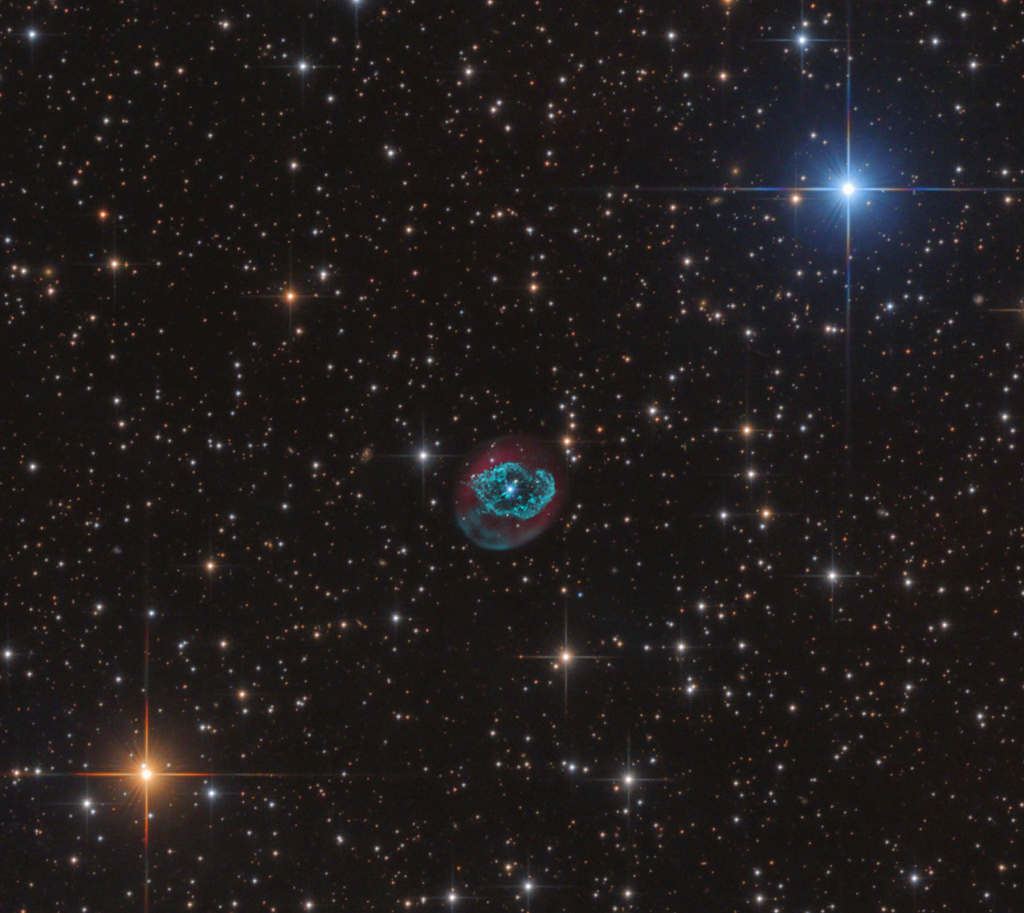
Planetary nebula Abell 78 stands out in this colorful telescopic skyscape. In fact the colors of the spiky Milky Way stars depend on their surface temperatures, both cooler (yellowish) and hotter (bluish) than the Sun. But Abell 78 shines by the characteristic emission of ionized atoms in the tenuous shroud of material shrugged off from an intensely hot central star. The atoms are ionized, their electrons stripped away, by the central star's energetic but otherwise invisible ultraviolet light. The visible blue-green glow of loops and filaments in the nebula's central region corresponds to emission from doubly ionized oxygen atoms, surrounded by strong red emission from electrons recombining with hydrogen atoms. Some 5,000 light-years distant toward the constellation Cygnus, Abell 78 is about three light-years across. A planetary nebula like Abell 78 represents a very brief final phase in stellar evolution that our own Sun will experience ... in about 5 billion years.