Planetary Nebula
An expanding shell of ionized gas ejected from a red giant star in the late stages of stellar evolution. Despite the name, it has no connection to planets. The glowing gas is illuminated by the hot core of the dying star.
Source: science.nasa.gov
APODs including "Planetary Nebula"
Webb's Southern Ring Nebula
14/07/2022
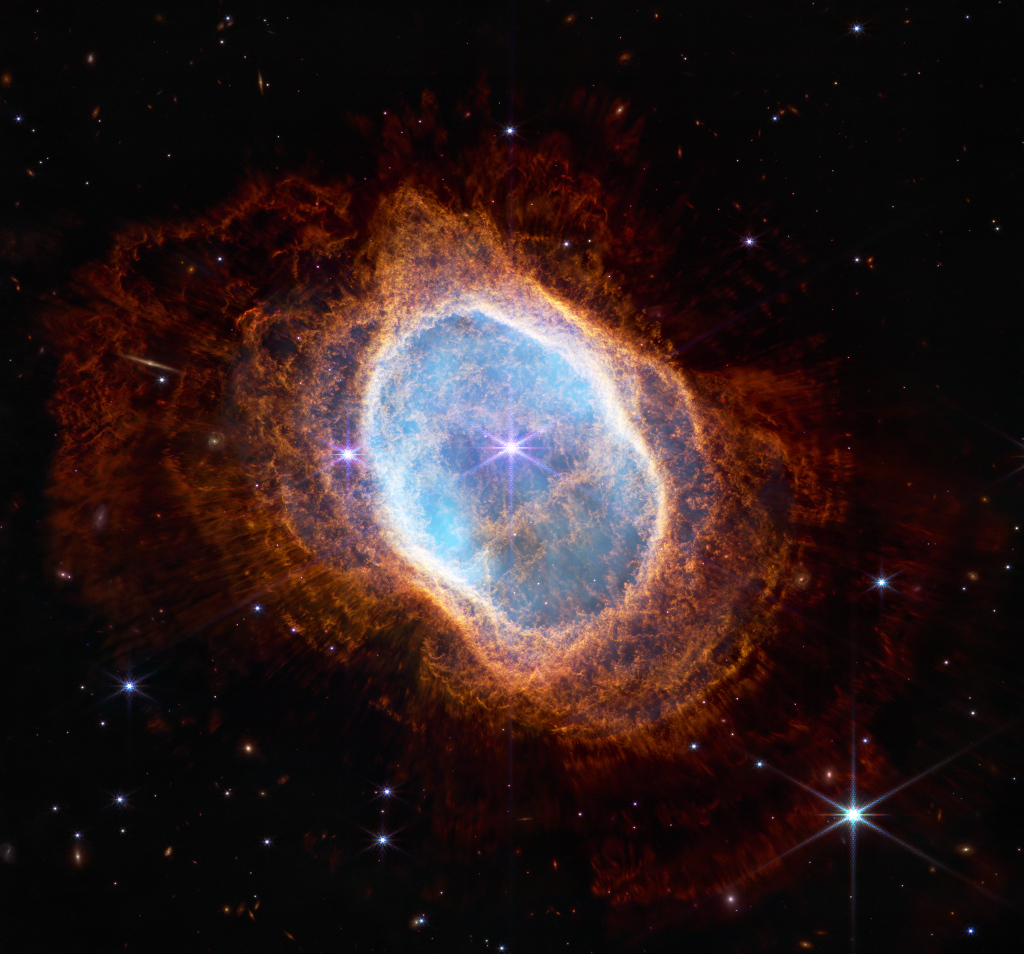
Cataloged as NGC 3132 the Southern Ring Nebula is a planetary nebula, the death shroud of a dying sun-like star some 2,500 light-years from Earth. Composed of gas and dust the stunning cosmic landscape is nearly half a light-year in diameter, explored in unprecedented detail by the James Webb Space Telescope. In this NIRCam image the bright star near center is a companion of the dying star. In mutual orbit, the star whose transformation has ejected the nebula's gas and dust shells over thousands of years is the fainter stellar partner. Evolving to become a white dwarf, the faint star appears along the diffraction spike extending toward the 8 o'clock position. This stellar pair's orbital motion has resulted the complex structures within the Southern Ring Nebula.