Planetary Nebula
An expanding shell of ionized gas ejected from a red giant star in the late stages of stellar evolution. Despite the name, it has no connection to planets. The glowing gas is illuminated by the hot core of the dying star.
Source: science.nasa.gov
APODs including "Planetary Nebula"
The Ring Nebula from Webb and Hubble
14/08/2023
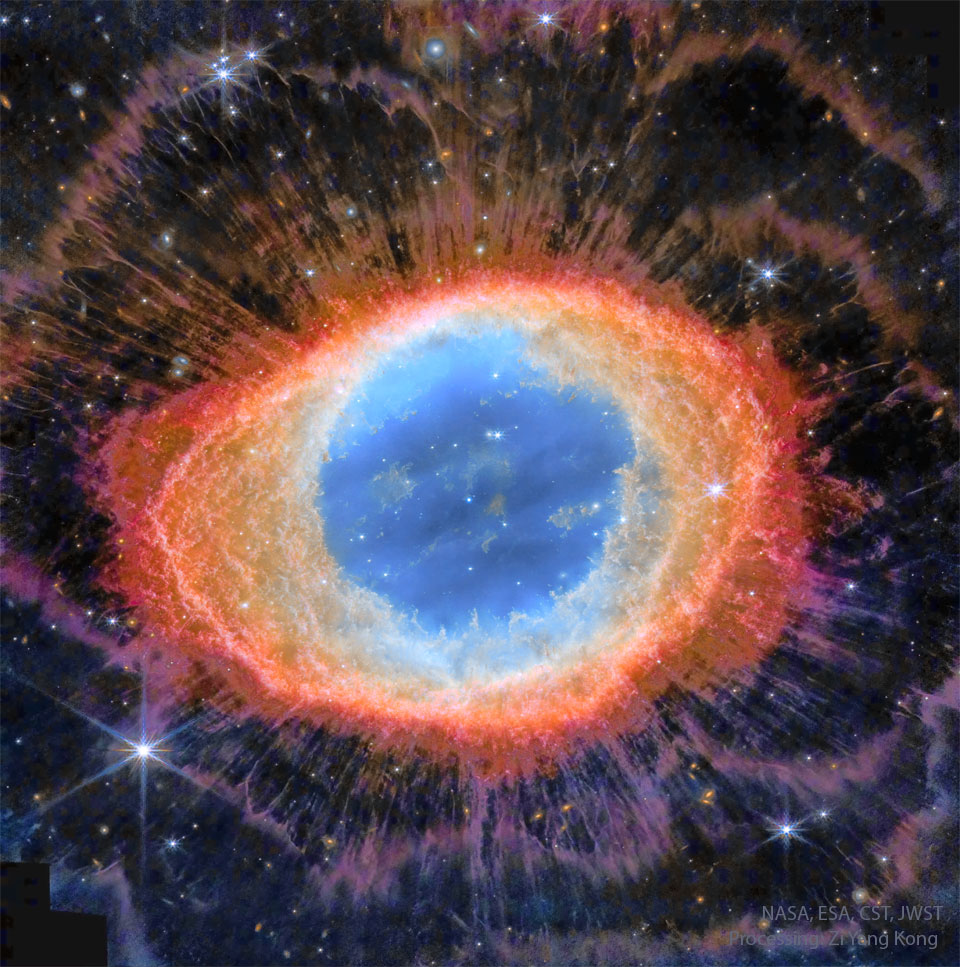
The Ring Nebula (M57), is more complicated than it appears through a small telescope. The easily visible central ring is about one light-year across, but this remarkable combined exposure by the James Webb Space Telescope and the Hubble Space Telescope explores this popular nebula with deep exposures in visible and infrared light. Strings of gas, like eyelashes around a cosmic eye, become evident around the Ring in this digitally enhanced featured image in assigned colors. These long filaments may be caused by shadowing of knots of dense gas in the ring from energetic light emitted within. The Ring Nebula is an elongated planetary nebula, a type of gas cloud created when a Sun-like star evolves to throw off its outer atmosphere to become a white dwarf star. The central oval in the Ring Nebula lies about 2,500 light-years away toward the musical constellation Lyra.