Planetary Nebula
An expanding shell of ionized gas ejected from a red giant star in the late stages of stellar evolution. Despite the name, it has no connection to planets. The glowing gas is illuminated by the hot core of the dying star.
Source: science.nasa.gov
APODs including "Planetary Nebula"
GK Per: Nova and Planetary Nebula
30/04/2024
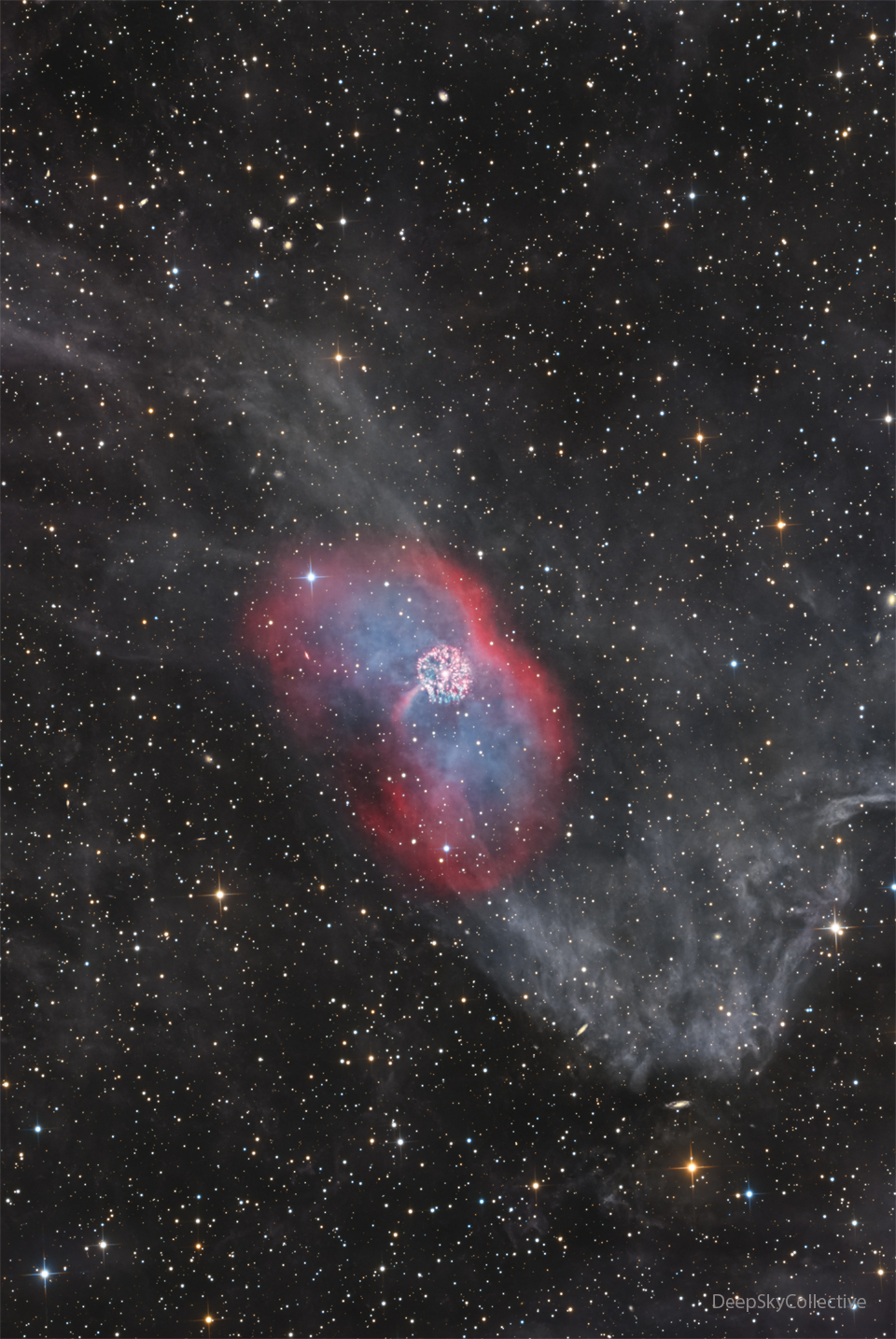
The star system GK Per is known to be associated with only two of the three nebulas pictured. At 1500 light years distant, Nova Persei 1901 (GK Persei) was the second closest nova yet recorded. At the very center is a white dwarf star, the surviving core of a former Sun-like star. It is surrounded by the circular Firework nebula, gas that was ejected by a thermonuclear explosion on the white dwarf's surface -- a nova -- as recorded in 1901. The red glowing gas surrounding the Firework nebula is the atmosphere that used to surround the central star. This gas was expelled before the nova and appears as a diffuse planetary nebula. The faint gray gas running across is interstellar cirrus that seems to be just passing through coincidently. In 1901, GK Per's nova became brighter than Betelgeuse. Similarly, star system T CrB is expected to erupt in a nova later this year, but we don't know exactly when nor how bright it will become.