Planetary Nebula
An expanding shell of ionized gas ejected from a red giant star in the late stages of stellar evolution. Despite the name, it has no connection to planets. The glowing gas is illuminated by the hot core of the dying star.
Source: science.nasa.gov
APODs including "Planetary Nebula"
Jones-Emberson 1
12/07/2024
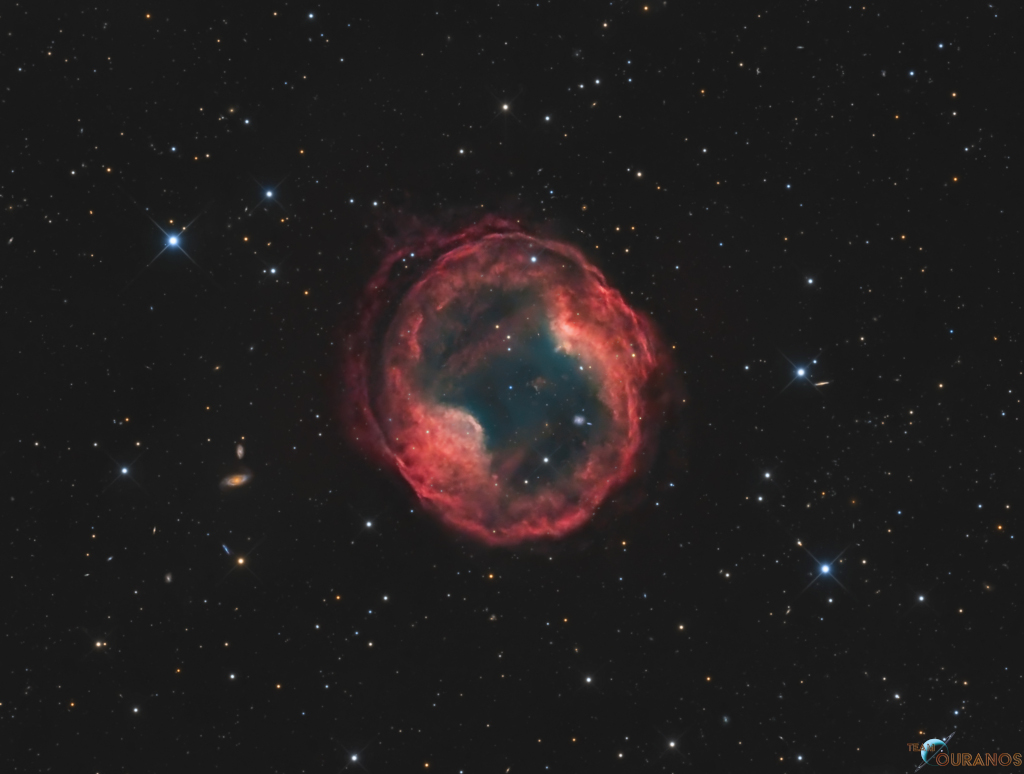
Planetary nebula Jones-Emberson 1 is the death shroud of a dying Sun-like star. It lies some 1,600 light-years from Earth toward the sharp-eyed constellation Lynx. About 4 light-years across, the expanding remnant of the dying star's atmosphere was shrugged off into interstellar space, as the star's central supply of hydrogen and then helium for fusion was depleted after billions of years. Visible near the center of the planetary nebula is what remains of the stellar core, a blue-hot white dwarf star. Also known as PK 164 +31.1, the nebula is faint and very difficult to glimpse at a telescope's eyepiece. But this deep image combining over 12 hours of exposure time does show it off in exceptional detail. Stars within our own Milky Way galaxy as well as background galaxies across the universe are scattered through the clear field of view. Ephemeral on the cosmic stage, Jones-Emberson 1 will fade away over the next few thousand years. Its hot, central white dwarf star will take billions of years to cool.